Key Benefits and Lasting Impact of Early Intervention Programs
Early intervention programs are coordinated services that identify, assess, and support infants and young children who show signs of developmental delay or disability, and they work because the brain’s early plasticity makes targeted supports especially effective. Early intervention accelerates language, cognitive, social, and motor skill acquisition by combining screening, individualized planning, and evidence-based therapies, producing measurable short-term gains that set the stage for long-term academic readiness. Families facing concerns about speech, social engagement, or milestone delays often experience relief when structured supports reduce stress and build practical strategies for daily life. This article explains what early intervention programs are, outlines immediate benefits children typically show, describes how multidisciplinary developmental support services operate, summarizes long-term impacts for families and systems, and provides clear steps parents can take to access services and schedule assessments. Throughout, the discussion uses terms like early support services, child development therapy, and developmental support services to make the pathways from screening to outcomes concrete and actionable. By connecting mechanisms, typical outcomes, and practical next steps, readers will gain both the conceptual framework and the how-to steps needed to pursue early intervention for their child.
What Are Early Intervention Programs and Why Are They Important?
Early intervention programs are organized services for infants and young children that screen for developmental concerns, conduct formal assessments, and develop individualized plans to address delays or disabilities. These programs function by detecting atypical development early, leveraging neuroplasticity during critical windows of learning to improve trajectories in language, motor skills, and social-emotional regulation. The importance of timing rests on biological and environmental mechanisms: early stimulation and targeted therapy reinforce neural pathways when they are most malleable, which increases the likelihood of lasting gains. Families benefit because early supports reduce cascading challenges that otherwise compound over time, such as academic struggles or behavioral problems. Understanding these foundations clarifies why prompt screening and action are central to effective child development support.
Defining Early Childhood Development Programs and Their Goals
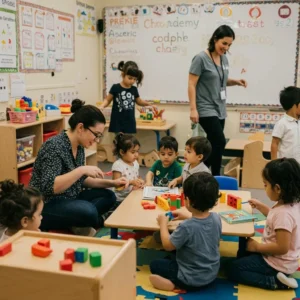
Early childhood development programs include a range of models—center-based preschools, home-based services, and therapy-focused clinics—that aim to promote age-appropriate milestones and school readiness. Programs typically start with developmental screening, followed by assessment and an individualized family service plan (IFSP) or similar roadmap that specifies goals, therapy frequency, and family coaching strategies. The primary goals are to improve communication and motor skills, support social-emotional regulation, and empower caregivers with practical routines that generalize gains into daily life. For example, a center-based early learning intervention program might combine play-based curricula with weekly speech therapy and caregiver coaching to accelerate language milestones. Clear definitions and goals help families compare program models and select the setting that best fits a child’s needs and family routines.
How Early Learning Supports Developmental Delays in Children
Early learning environments support developmental delays by embedding targeted interventions within everyday interactions and structured activities that reinforce skill practice. Screening identifies specific areas of need—such as receptive language or fine motor coordination—and interventions integrate therapy techniques into play, mealtime, and routines so that progress occurs across contexts. For instance, a child with delayed expressive language may receive speech therapy goals that caregivers practice during shared book reading, which strengthens generalization. This approach yields faster improvements than isolated therapy alone because repeated, meaningful practice reinforces newly formed neural connections. Recognizing how early learning scaffolds skill acquisition helps families see why consistent, context-rich supports produce durable change.
What Are the Immediate Benefits of Early Intervention for Children?
Early intervention produces measurable short-term benefits across cognitive, social, communication, and behavioral domains by aligning assessment-driven goals with intensive, developmentally appropriate activities. Programs accelerate acquisition of foundational skills—such as vocabulary, turn-taking, and self-regulation—through targeted therapy sessions, enriched learning environments, and caregiver coaching that increases daily practice. Rapid improvements often appear within weeks to months because focused input leverages the child’s learning window and reduces the accumulation of delays that would otherwise hinder classroom readiness. The immediate gains not only improve child functioning but also reduce caregiver stress by providing tools and predictable strategies for home and community settings. These short-term outcomes form the basis for improved school performance and lower long-term service needs.
Early intervention frequently demonstrates these top short-term benefits:
- Improved language and communication: Focused speech therapy and caregiver strategies increase expressive and receptive vocabulary.
- Enhanced social interaction: Structured play and peer activities improve turn-taking, joint attention, and emotional reciprocity.
- Better cognitive and problem-solving skills: Enriched learning opportunities accelerate early math and reasoning foundations.
- Reduced challenging behaviors: Early behavior plans and consistent routines promote regulation and decrease tantrums.
- Faster progress on developmental milestones: Assessment-driven goals shorten the time to reach age-appropriate motor, language, and social benchmarks.
Below is a compact comparison of immediate benefit domains, typical interventions, and expected short-term outcomes to help families weigh priorities quickly.
This comparison helps parents prioritize which interventions to pursue first and illustrates how specific supports map to observable short-term gains.
For parents or caregivers ready to move from evidence to action, consider reaching out to local early support services and information hubs to learn about enrollment processes and to schedule evaluations or tours. The organization behind this resource can help guide families toward appropriate referrals and support options, offering a starting point for inquiries and next steps.
Enhancing Cognitive and Social Skills Through Early Support
Targeted early support enhances cognitive and social skills by combining enriched learning experiences with scaffolded interaction that progressively challenges the child. Mechanisms include increased exposure to new vocabulary, structured problem-solving tasks, and guided peer interactions that promote perspective-taking and cooperative play. Practical activities—such as scaffolding during puzzles or turn-taking games—create repeated opportunities for the child to practice emerging skills, enabling consolidation of neural pathways that underpin reasoning and social understanding. Caregiver coaching translates therapeutic strategies into everyday routines so that learning continues outside formal sessions. These methods yield steady gains in attention, concept formation, and social engagement that teachers typically notice upon school entry.
Improving Communication and Behavioral Outcomes in Young Children
Communication and behavior improve rapidly when services use individualized speech-language targets alongside behavior support plans that include caregiver-led strategies and environmental modifications. Speech-language interventions focus on expanding functional vocabulary, improving sentence structure, and increasing pragmatic skills like greeting and requesting; behavioral strategies emphasize predictable routines, antecedent supports, and reinforcement that encourage alternative behaviors. Short illustrative vignettes show that consistent practice—such as implementing a visual schedule and practicing requests during meals—reduces problem behaviors while boosting communicative attempts. Multidisciplinary coordination ensures that speech goals align with behavior plans so that progress in one domain supports gains in the other. This integrated approach reduces frustration and enhances the child’s ability to participate in family and classroom activities.
How Do Child Developmental Support Services Contribute to Growth?
Child developmental support services contribute to growth by assembling multidisciplinary teams—therapists, educators, and family coaches—that assess needs and implement coordinated, measurable plans. These services operate through cycles of screening, assessment, individualized family service plan development, intervention, and progress monitoring, which together provide both short-term gains and a trajectory toward independence. Each professional brings distinct expertise: speech therapists target communication, occupational therapists address sensory and fine motor needs, and behavioral specialists analyze functions of behavior and design support systems. Coordinated services ensure that therapies are mutually reinforcing and that caregiver training is prioritized so gains transfer to daily routines. Understanding these organizational and clinical mechanisms clarifies why comprehensive services outperform isolated referrals.
Role of Specialized Therapies in Early Intervention Programs
Specialized therapies—speech therapy, occupational therapy, physical therapy, and behavioral therapy—each address specific developmental domains while contributing to holistic progress through coordinated planning. Speech therapy targets expressive and receptive language, which supports classroom learning and social connection, while occupational therapy enhances fine motor skills and sensory processing that underlie self-care and learning tasks. Physical therapy focuses on gross motor milestones necessary for mobility and play, and behavioral therapy implements function-based strategies to reduce challenging behaviors. The following summary highlights what each therapy typically targets and the common outcomes families can expect in early months.
Introductory table summarizing therapy targets and typical short-term outcomes.
This table clarifies how each therapy contributes to a child’s functional progress and helps caregivers prioritize assessments based on observed needs.
When families discover therapies are available locally, they can arrange assessments through regional early support services or community information hubs that guide referrals and scheduling. As an information hub, the organization providing this overview supports families by outlining typical assessment pathways and suggesting questions to ask providers, bridging the gap between clinical recommendations and practical access.
Family Involvement and Education in Supporting Child Development
Family involvement and education multiply the effectiveness of professional therapies by turning treatment strategies into daily practice and habit. Caregiver coaching teaches parents simple, evidence-backed techniques—such as modeling language during routines, using visual supports, and implementing consistent reinforcement—that create thousands of practice opportunities each week. Practical tips include embedding learning targets into play, using short, frequent practice sessions, and documenting progress to share with the team. Questions parents can ask providers—about goal measurement, generalization strategies, and routine integration—help ensure alignment between clinic goals and home implementation. When families are active partners, progress accelerates and outcomes generalize across settings.
What Is the Long-Term Impact of Early Childhood Intervention?
Early childhood intervention has long-term impacts that extend into school performance, social-emotional health, and reduced need for intensive special education and healthcare spending over time. Mechanisms include early gains in foundational skills that enable children to access grade-level instruction, improved self-regulation that facilitates classroom behavior, and strengthened family capacity to support learning, all of which compound into better outcomes across childhood and adolescence. Evidence from longitudinal program evaluations suggests that children who receive timely supports are more likely to demonstrate school readiness, stay with peers in general education settings, and require fewer specialized services later. Translating evidence into family decisions clarifies the value proposition of early action and highlights how initial investments in services often yield net benefits for households and systems.
Introductory table summarizing long-term outcomes, evidence mechanisms, and practical implications for families.
This table summarizes why early gains translate into meaningful long-term benefits and helps families weigh short-term effort against future return.
Academic and Social Success Linked to Early Support
Academic and social success trace back to early mastery of language, attention, and self-regulation skills that form the scaffolding for classroom learning and peer engagement. Early intervention often improves emergent literacy and numeracy skills, which predict later achievement, while social competence supports cooperative learning and relationship building. Cause-and-effect relationships emerge when early supports close learning gaps before they widen, thereby preventing repeated catch-up cycles that undermine confidence and school engagement. Illustrative examples show children who receive early speech and social skills supports enter kindergarten with stronger participation and are more likely to be successful in mainstream classrooms. These trajectories demonstrate how early investments affect educational pathways over the long term.
Reducing Future Special Education Needs and Healthcare Costs
Early intervention can reduce the intensity and duration of later special education and healthcare services by addressing needs while they are still developing and more responsive to treatment. Mechanisms include prevention of secondary complications, improved functional independence, and early caregiver skill-building that reduces reliance on external services. For families, this can mean fewer costly evaluations, less need for specialized placements, and improved quality of life as children gain independence. Translating these system-level benefits into family decisions helps caregivers understand the potential long-term economic and practical advantages of early action, reinforcing the rationale for timely screening and enrollment in services when concerns arise.
How Can Parents and Caregivers Access Early Intervention Programs?
Parents and caregivers can access early intervention through a sequence of screening, referral, assessment, individualized plan development, and service initiation, with local agencies, pediatricians, and information hubs providing entry points. Clear steps make the pathway manageable and reduce uncertainty about documentation, timelines, and what to expect at first appointments. Early screening is widely recommended at key ages, and when concerns are flagged, providers will usually recommend diagnostic assessment followed by an IFSP or similar plan tailored to the child and family. Knowing which signs to watch for and how to navigate referrals empowers caregivers to act confidently and secure timely support.
Families can follow these practical steps to access services:
- Request a developmental screening from your pediatrician or local early support service.
- If screening flags concerns, ask for a formal assessment and an individualized family service plan (IFSP).
- Coordinate multidisciplinary evaluations and prioritize initial goals with providers.
- Begin therapy sessions, request caregiver coaching, and schedule regular progress reviews.
- Document communications and follow up on referrals to ensure services start promptly.
These steps demystify the process and create clear expectations for timing, documentation, and family roles during the referral and assessment pathway.
Introductory table that maps steps, who to contact, and typical timelines to help parents plan the process.
This table provides an actionable timeline so families can anticipate each phase and prepare questions and documentation.
For practical navigation, consider arranging visits or tours and asking providers about typical session formats, progress measurement, and family coaching options. The organization referenced in this article can assist families in clarifying next steps, identifying local assessment resources, and preparing for initial visits.
Identifying Signs That Indicate Need for Early Intervention
Families should monitor developmental milestones and be alert to red flags across communication, motor, cognitive, and social domains that warrant screening or assessment. Common indicators include limited babbling or few words by expected ages, persistent difficulty with eye contact or shared attention, delayed rolling/walking or persistent tone concerns, and frequent inability to engage in age-appropriate play. Regular screening at well-child visits—plus caregiver observation and documentation—helps build a clear picture that professionals can assess. Early action is recommended when multiple red flags appear or when a caregiver’s concern is persistent, because timely assessment enables faster initiation of targeted supports.
Key red flags by domain include:
- Communication delays: Minimal gestures or fewer than expected words for age.
- Motor delays: Limited crawling, walking, or persistent tone concerns.
- Social/behavioral signs: Little interest in peers or difficulty with self-soothing.
- Cognitive indicators: Difficulty learning new routines or solving simple problems.
This checklist gives parents concrete signs to watch and supports the decision to request a screening or assessment.
Navigating Available Child Developmental Support Services
Navigating services involves preparing documentation (developmental history, school or pediatric notes), asking specific questions during intake, and understanding how progress is measured and reported. Practical tips include requesting copies of assessment reports, clarifying who will coordinate services, asking about family coaching and home-practice expectations, and confirming timelines for progress reviews. Expect initial appointments to include observation, standardized assessments, and collaborative goal-setting with the family; multidisciplinary coordination should produce an IFSP or similar plan with measurable goals. Families who bring notes about observed behaviors and daily routines help clinicians create realistic, functional goals that fit home life.
A final actionable checklist helps parents prepare:
- Gather developmental history and any prior reports.
- List specific concerns and examples of when they occur.
- Prepare questions about therapy frequency, caregiver training, and measurement of progress.
- Ask about next-step timelines and who will be the service coordinator.
These practical steps reduce uncertainty and empower families to advocate effectively for timely, coordinated supports that promote lasting child development.