The Importance and Benefits of Reading Aloud to Young Children for Early Literacy Development
Reading aloud to young children is the simple, evidence-based practice of an adult or older child sharing books and stories with infants, toddlers, and preschoolers to build language connections and early literacy skills. This activity exposes children to new vocabulary, narrative structure, and conversational turns while strengthening neural pathways that support listening comprehension and later independent reading. Parents and educators who prioritize story time see improvements in vocabulary, attention, emotional regulation, and kindergarten readiness, making read-aloud routines a high-impact early childhood strategy. This article explains the key benefits of reading aloud, shows how classroom and home practices reinforce those benefits, reviews research linking early read-alouds to later achievement, and offers age-specific techniques parents can use today. Readers will find practical tips, curated book and activity suggestions, and examples of program-level implementation so caregivers and providers can turn daily story time into measurable learning opportunities. Throughout the piece we use current research and semantic strategies to clarify how reading aloud supports language acquisition, phonological awareness, and social-emotional development.
What Are the Key Benefits of Reading Aloud to Young Children?
Reading aloud delivers multiple, overlapping benefits across language, cognitive, emotional, and social domains by providing repeated, contextualized language exposure and predictable narrative frameworks that support memory and inference. Through shared reading, children encounter new words in context, practice listening and attention skills, and observe models of emotion labeling and social interaction—mechanisms that translate into measurable outcomes such as expanded vocabulary and better comprehension. The following list summarizes the primary domains where read-alouds demonstrate consistent gains and points to practical ways families can prioritize story time within daily routines. After summarizing benefits, the table below will map mechanisms to short-term and long-term outcomes for quick scanning and classroom use.
Reading aloud to young children produces a cascade of developmental effects that support later school success, and the next section will show a concise mapping of those benefits and mechanisms in table form.
- Language Growth: Repeated exposure to varied vocabulary and syntax improves word learning and expressive language.
- Cognitive Skills: Narrative structure and questioning build memory, attention, and inferential thinking.
- Emotional Regulation: Stories model emotions and coping, helping children label and manage feelings.
- Social Development: Shared reading promotes turn-taking, conversational norms, and empathy.
These benefits combine to create a literacy-rich foundation that prepares children for classroom demands and fosters a love of reading that supports lifelong learning.
Different benefit domains are produced by specific mechanisms and lead to recognizable outcomes in early childhood settings.
This table highlights how routine read-aloud practices translate into concrete, observable skills that educators and parents can track over time.
How Does Reading Aloud Support Vocabulary Growth and Language Skills?
Reading aloud supports vocabulary growth by presenting words in rich contexts, using repetition across books and conversations, and exposing children to syntactic patterns they would rarely hear in everyday speech. When caregivers emphasize new words, offer short definitions, and connect terms to gestures or objects, children form stronger semantic links that improve retention and expressive use. Current research indicates that cumulative word exposure—both in frequency and variety—predicts later vocabulary size, and simple metrics like daily reading minutes and number of unique words matter for early language trajectories. At home and in classrooms, caregivers can boost learning by pausing to define unfamiliar words, asking prediction questions, and encouraging children to retell story parts; these strategies increase active processing and integrate new vocabulary into the child’s lexicon. The next paragraph will expand on how these language gains support broader cognitive and social outcomes.
In What Ways Does Reading Aloud Enhance Cognitive and Emotional Development?
Reading aloud enhances cognitive development by training attention to sequential events, strengthening working memory through story recall, and supporting inference-making as children learn to predict plot outcomes. Emotionally, shared stories give children a safe space to explore feelings and practice perspective-taking, which strengthens emotional intelligence and regulation skills. Teachers and parents who use interactive techniques—such as pausing to ask how characters feel or prompting children to solve a character’s problem—promote both higher-order thinking and social problem solving. These cognitive and emotional gains feed directly into classroom readiness behaviors, and the following section will describe how curricula and home routines can intentionally embed read-alouds to amplify these outcomes.
How Does Chroma Early Learning Academy Integrate Reading Aloud into Its Early Literacy Programs?
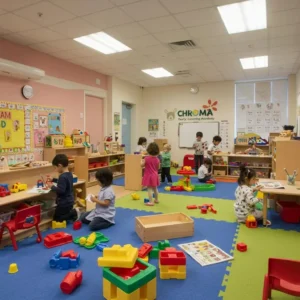
Chroma Early Learning Academy embeds reading aloud into daily routines using a literacy-rich environment that emphasizes language interactions and developmentally appropriate story experiences tailored to each age group. The academy’s PrismPath™ learning model situates read-alouds within a balanced approach—addressing physical, emotional, social, academic, and creative development—so teachers use story time as a platform for vocabulary teaching, phonological play, and social-emotional learning. Classrooms follow predictable rhythms where read-alouds are paired with song, movement, and follow-up activities to reinforce comprehension and make language practice multisensory. Below is a mapping that connects program age groups to specific read-aloud practices and expected literacy outcomes to help parents and providers see concrete examples of implementation.
Chroma’s programmatic use of read-alouds aligns reading practice with hands-on follow-ups and age-appropriate scaffolds, and the next subsection will define PrismPath™ in more detail.
What Is the PrismPath™ Curriculum and Its Role in Literacy Development?
PrismPath™ is Chroma Early Learning Academy’s proprietary learning model that intentionally integrates multiple developmental domains—physical, emotional, social, academic, and creative—so literacy emerges alongside holistic growth. Within PrismPath™, reading aloud is not isolated; books are used as springboards for movement, dramatic play, and social problem solving, which reinforces language in varied contexts. For example, a preschool story about a market might be followed by role-play where children practice vocabulary and counting, linking print awareness to real-world application. This integrated approach increases opportunities for repetition and retrieval—key mechanisms for vocabulary retention—and helps young learners apply new words and narrative concepts across settings. The following subsection will describe how these practices are adapted by age to maximize learning.
How Are Reading Aloud Practices Adapted Across Different Age Groups at Chroma?
Chroma adapts read-aloud strategies by developmental stage: infants receive language-rich one-on-one interactions with sensory books, toddlers engage in short interactive stories with gestures and predictable phrases, preschoolers experience dialogic reading that prompts retell and phonological play, and older children take part in discussion-based read-alouds that emphasize comprehension and inference. Teachers scaffold complexity over time—starting with sound play and shared attention, then introducing print concepts and phonemic awareness, and finally encouraging critical response and connection-making for school-age learners. Each classroom pairs stories with purposeful activities such as letter hunts, story dramatizations, and comprehension prompts to deepen retention and transfer. This age-mapping underscores how intentional scaffolding during read-alouds creates a developmental ladder from first words to reading readiness.
Why Is Reading Aloud Critical for Kindergarten Readiness and Academic Success?
Reading aloud builds core skills that map directly onto kindergarten standards—listening comprehension, print awareness, vocabulary, and phonological awareness—so consistent shared reading is a strong predictor of school readiness and later academic achievement. Early exposure to narrative forms and complex language supports children’s ability to follow multi-step directions, understand classroom routines, and access curriculum content across subjects. Research highlighted in contemporary reviews links frequency and quality of early language experiences to later reading proficiency, and policy-aligned programs such as Georgia’s Pre-K emphasize daily literacy rhythms that include read-alouds, shared writing, and phonemic activities. To illustrate how read-alouds translate into readiness skills, the next paragraphs enumerate specific school-readiness behaviors and summarize the research connecting early exposure to third-grade outcomes.
Reading aloud cultivates specific skills that children need to succeed on day one of kindergarten.
- Listening comprehension: Children learn to extract main ideas and sequence events from stories.
- Print awareness: Books teach that print carries meaning and how to track text left to right.
- Phonological awareness: Rhymes and sound play during read-alouds build the foundation for decoding.
How Does Early Literacy Through Reading Aloud Prepare Children for School?
Early literacy built through read-alouds prepares children by developing the attention, memory, and language routines teachers rely on in early grades. Shared reading models expectations—sitting for short group activities, listening to a teacher-led text, and responding to questions—which mirrors common classroom tasks and reduces the instructional gap on day one. Additionally, when children come with larger vocabularies and stronger narrative recall, they engage more readily with curriculum content, require less remediation, and show higher achievement trajectories. Practical classroom examples include small-group retell cycles and teacher-guided prediction prompts that mirror home dialogic reading strategies, creating continuity between home and school. The following subsection will summarize research linking these early practices to later reading outcomes.
What Research Supports the Link Between Reading Aloud and Third-Grade Reading Proficiency?
Multiple longitudinal studies and syntheses show that early language environments—measured by conversation quantity and book exposure—predict later reading outcomes, and researchers often cite cumulative vocabulary exposure as a key mediator of third-grade reading proficiency. Studies describe phenomena such as the “word gap” where children with richer early language input enter school with larger vocabularies and stronger decoding readiness, which in turn supports comprehension in later elementary grades. Recent reviews emphasize that both quantity and quality of interactions matter: dialogic, responsive read-alouds produce stronger gains than passive listening alone. For parents, this means consistent, interactive reading routines and exposure to varied vocabulary across contexts can produce measurable long-term benefits for academic success.
What Practical Tips Can Parents Use to Effectively Read Aloud at Home?
Effective read-aloud at home combines age-appropriate book selection, interactive techniques, and predictable routines that make story time frequent and meaningful. For caregivers, small changes—using expressive voices, asking open-ended questions, and linking new words to everyday objects—significantly increase engagement and retention. Below are actionable, age-labeled tips parents can apply immediately to boost vocabulary, comprehension, and love of reading. After the tips list, a short table provides quick how-to guidance by age group for easy reference.
Start with simple daily routines that make reading predictable and joyful for children of all ages.
- Make it interactive: Pause to ask children to predict or point to pictures during the story.
- Repeat key vocabulary: Reinforce new words across days and in real-life situations.
- Use varied voices and gestures: Expressive reading holds attention and models prosody.
- Follow up with play: Turn story themes into short games or role-play to extend learning.
Chroma Early Learning Academy supports families with practical resources, parent checklists, and guided activities that align with these age-specific strategies; families are encouraged to request resources or schedule a tour to see literacy-rich routines in action.
Which Reading Aloud Techniques Foster Engagement and Comprehension?
Dialogic reading is a proven technique where adults prompt children with questions, expand responses, and encourage retelling, which increases active processing and deepens comprehension. Techniques include asking open-ended “wh” questions, inviting children to predict outcomes, and using expansion—repeating a child’s phrase and adding a new word—to model richer language. For younger children, gesture and repetition scaffold understanding; for older preschoolers, asking inferential questions builds critical thinking. Caregivers can use short scripts such as: “What is happening? Why do you think that happened? What do you think will happen next?” to structure interactive sessions that are both predictable and challenging. The next paragraph will suggest specific activities and book types to pair with these techniques.
What Are Recommended Books and Activities to Support Early Literacy at Home?
Selecting engaging, developmentally appropriate books and pairing them with simple activities turns reading into an active learning routine that supports vocabulary, phonological awareness, and comprehension. For infants, board books with rhythm and high-contrast images work well; toddlers benefit from lift-the-flap and repetition books; preschoolers gain from predictable-cumulative texts and simple informational books that introduce content vocabulary. Activities like letter hunts, rhyme games, and sensory story extensions (e.g., using props) reinforce learning and make transfer to play natural. Below is a short bulleted list of activity ideas parents can rotate weekly.
- Use a “story bag” with simple props to act out key scenes from the book.
- Play a rhyme-matching game after reading a rhyming book to build phonological awareness.
- Create a one-minute “book talk” where the child tells a friend or family member the main idea.
These activities extend story learning into play and daily routines, making vocabulary and concepts stick longer.
How Does Reading Aloud Foster Parent-Child Bonding and Social Skills?
Shared reading creates predictable, emotionally safe interactions that strengthen attachment and model social communication, which supports both bonding and the development of social skills. When caregivers respond warmly and attentively during read-alouds, children learn that communication is reciprocal and that shared attention is rewarding. Stories also provide opportunities to discuss perspectives and emotions, offering rehearsal for real-life social situations and promoting empathy. The paragraphs below describe techniques for emotion coaching through stories and how read-alouds can foster conversational norms such as turn-taking and respectful listening.
When reading becomes a consistent, warm routine, children view books as sources of comfort and social learning.
- Emotion coaching through stories: Pause to name and discuss characters’ feelings to build emotion vocabulary.
- Turn-taking practice: Shared reading routines teach children to wait and respond in conversation.
- Modeling social language: Caregivers demonstrate polite questions and elaborative responses during read-alouds.
In What Ways Does Shared Reading Strengthen Emotional Intelligence?
Shared reading offers low-stakes opportunities to label emotions, discuss motives, and practice problem-solving, all of which build emotional vocabulary and self-regulation skills. Caregivers can enhance emotional learning by asking questions like, “How do you think she felt?” and prompting children to suggest alternative endings or coping strategies for characters. Repeatedly discussing feelings in predictable contexts helps children generalize those labels to their own experiences, improving emotional awareness and regulation. Practical after-reading activities such as “feeling faces” or role-play teach children to identify emotions and try out calm-down strategies, linking story-based reflection to daily life. This emotional practice creates a bridge to social skills work described in the next subsection.
How Does Reading Aloud Encourage Social Development in Young Children?
Reading aloud encourages social development by modeling conversational turn-taking, demonstrating perspective-taking through character discussion, and teaching the pragmatic norms of storytelling such as staying on topic and listening. Group story times build cooperative skills as children learn to share space, take cues from the reader, and respond to peers’ ideas, which translates into better classroom participation. Teachers often use predictable read-aloud structures—choral responses, call-and-response, and guided retell—to scaffold social participation for children who struggle with group dynamics. Embedding explicit social language and cooperative activities after reading helps children practice social scripts they will encounter in school and peer settings.
What Are the Long-Term Impacts of Reading Aloud on Lifelong Reading Habits?
Early read-aloud experiences contribute to lifelong reading habits by creating positive associations with books, establishing predictable reading rituals, and exposing children to diverse genres and perspectives that expand curiosity. When reading is joyful and linked to meaningful conversation, children are more likely to choose books independently and sustain reading through school and adulthood. In addition, exposure to diverse literature during early years supports critical thinking and cultural competence by presenting multiple viewpoints and fostering inference skills. The next paragraphs outline strategies families and providers can use to sustain reading routines and how early exposure promotes higher-order thinking over time.
Sustained read-aloud practices build habits and cognitive frameworks that support critical engagement with text across the lifespan.
- Make reading a ritual: Consistent times for story increase predictability and attachment to books.
- Offer choice and variety: Rotating genres and authors keeps interest and models lifelong reading curiosity.
- Encourage discussion: Asking higher-order questions over time promotes evaluative and inferential thinking.
How Can Early Reading Aloud Experiences Cultivate a Lifelong Love of Reading?
Cultivating a lifelong love of reading begins with joyful, pressure-free reading rituals that respect children’s interests and choices while exposing them to a breadth of genres. Caregivers should balance read-alouds between favorite predictable texts (which build fluency and confidence) and new, diverse books (which broaden background knowledge and curiosity). Creating small family traditions—like a weekend “book share” or bedtime two-book rule—builds positive emotional associations with reading and models adult engagement with texts. Over time, offering choice and encouraging child-led selections reinforces autonomy and intrinsic motivation, both strong predictors of continued reading into adolescence and adulthood.
What Role Does Reading Aloud Play in Critical Thinking and Diverse Literary Exposure?
Reading aloud introduces children to multiple perspectives, complex plots, and cultural contexts that prompt inference, evaluation, and critical response—core elements of critical thinking. Adults can scaffold higher-order thinking by asking questions that require justification (“Why did the character do that?”) and comparison (“How is this character like someone we know?”), which trains children to analyze motives and consequences. Exposure to diverse authors and stories helps children recognize varied experiences and builds the background knowledge necessary for comprehension across subject areas. These practices not only support academic skills but also prepare children to engage thoughtfully with the world, and families seeking programmatic support may find value in literacy-rich environments that prioritize diverse, discussion-forward read-alouds.
Chroma Early Learning Academy’s literacy-rich classrooms, guided by the PrismPath™ approach, emphasize diverse literature and discussion-based read-alouds to promote critical thinking and sustained reading habits; families interested in exploring these approaches are encouraged to inquire about enrollment or schedule a tour to observe reading routines firsthand.