Inquiry-Based Learning at Chroma: Shaping Holistic Child Development
Inquiry-based learning places children’s questions, curiosities, and active exploration at the center of early education, turning natural wonder into structured opportunities for discovery. This article explains what inquiry-based learning is, why it works for young children, and how hands-on, child-led investigation strengthens critical thinking, collaboration, confidence, and kindergarten readiness. Parents will learn concrete classroom practices—like sensory investigations, simple experiments, and collaborative projects—that promote cognitive, social, emotional, and creative growth, and how these activities map to observable milestones. We also describe how Chroma Early Learning Academy implements inquiry-based approaches through its PrismPath™ curriculum and licensed, quality-rated programs across multiple Metro Atlanta locations, offering state-aligned Pre-K adaptations and trained educators who scaffold exploration. Read on for clear definitions, classroom examples, evidence-based mechanisms for retention and learning, activity ideas parents can observe at drop-off, and the specific ways inquiry-based early childhood education supports a lifelong love of learning.
What Is Inquiry-Based Learning and How Does It Enhance Early Childhood Education?
Inquiry-based learning is a child-centered approach in which children pursue questions through hands-on exploration while teachers facilitate with prompts, resources, and reflection. It works by converting curiosity into learning cycles—observe, ask, experiment, reflect—so children construct understanding through active experience rather than passive instruction. The mechanism supports deeper conceptual links because sensory engagement and hypothesis-testing form durable mental representations, leading to improved retention and transferable problem-solving skills. Parents seeking preschool critical thinking activities will notice more purposeful questioning, extended play around a topic, and emergent vocabulary tied to investigations. Below are the primary benefits parents can expect when inquiry learning is used thoughtfully in early childhood settings.
- Cognitive development: stronger pattern recognition and cause-effect reasoning.
- Social-emotional growth: improved collaboration, communication, and self-regulation.
- Long-term motivation: intrinsic curiosity that supports sustained engagement in learning.
These benefits create a foundation for kindergarten readiness and lifelong learning, which naturally leads to examining how a curriculum like PrismPath™ puts inquiry into daily practice.
How Does Chroma’s PrismPath™ Curriculum Implement Inquiry-Based Learning Principles?
Chroma’s PrismPath™ curriculum aligns inquiry-based learning with five developmental pillars—physical, emotional, social, academic, and creative—to ensure exploration supports holistic development. In practice, teachers set up investigation stations and provocations that invite child-led questions, then observe and document learning moments to plan extensions that deepen understanding. Educators are trained to use open-ended prompts and guided scaffolding—asking “What do you notice?” or “What happens if…?”—so children test ideas and iterate solutions while developing language and persistence. For infants through schoolagers, PrismPath™ adjusts materials and expectations, using sensory-rich bins for toddlers and project-based investigations for Pre-K and school-age children. This intentional structure ties exploration to measurable developmental outcomes while preserving child agency and wonder.
What Are the Core Elements of Child-Led Exploration and Teacher Facilitation?
Child-led exploration balances choice, investigation, and reflection with teacher facilitation that observes, provokes, documents, and extends learning. Teachers act as questioners and co-investigators rather than directors, providing materials, framing dilemmas, and modeling inquiry language while ensuring safety and routine. Typical classroom elements include sensory bins, learning centers with open-ended materials, investigation cards that suggest experiments, and documentation walls that capture evolving ideas and vocabulary. The mini-framework—observe → provoke → document → extend—helps teachers turn individual curiosities into group investigations and curriculum-aligned learning goals. This balance supports autonomy while ensuring children encounter progressively challenging problems that develop resilience and cognitive flexibility.
How Does Inquiry-Based Learning Foster Critical Thinking and Problem-Solving Skills in Young Children?
Inquiry-based learning fosters critical thinking by encouraging hypothesis-testing, causal reasoning, and iterative problem-solving during playful investigations. When children predict outcomes, manipulate materials, and test ideas, they practice comparing expectations to results and adjusting strategies—core processes of critical thinking and scientific reasoning. These mechanisms appear differently by age: toddlers experiment with cause-effect through block play, preschoolers compare variables in simple experiments, and Pre-K children complete multi-step projects that require planning and reflection. Below are concise mechanisms that translate inquiry into observable thinking skill development.
- Hypothesis testing: Children make predictions and verify through exploration.
- Pattern recognition: Repeated investigations reveal regularities and rules.
- Strategy iteration: Failed attempts prompt alternative approaches and persistence.
To illustrate age-specific implementations, the table below compares activity types and outcomes across typical early childhood age groups, helping parents see how inquiry scales with development.
Teachers extend these classroom processes through prompts and documentation that make thinking visible, which transitions naturally into concrete activities parents can look for during drop-off and pick-up.
What Activities at Chroma Develop Preschoolers’ Critical Thinking?
Preschool-level activities emphasize guided experiments, open-ended building challenges, and story-based problem scenarios that require children to plan and revise solutions. For example, water-table investigations encourage preschoolers to predict which objects will sink or float, test their ideas, and explain outcomes using new vocabulary. Building tasks with varied materials promote engineering thinking: children hypothesize how to make structures stable, test configurations, and iterate designs when collapses occur. Educator prompts—such as “How could we make that stronger?” or “What would happen if we changed this?”—extend thinking and scaffold metacognitive language. Observable indicators of growth include increased willingness to try alternative strategies, more complex explanations, and longer sustained focus on a single investigation.
How Does Hands-On Exploration Lead to Deeper Understanding and Retention?
Hands-on exploration gives children something concrete to notice, discuss and revisit. In a seed-growing activity, for example, children can compare what they see over time, learn new words and share their observations. A teacher can extend the conversation with questions and materials suited to the children’s interests and development. These experiences offer opportunities to practice thinking and communication without expecting every child to respond in the same way.
In What Ways Does Inquiry-Based Learning Cultivate Curiosity and a Lifelong Love for Learning?
Inquiry-based learning cultivates curiosity by prioritizing child questions and offering low-stakes opportunities to pursue interests, which builds intrinsic motivation and a positive identity as a learner. Autonomy and meaningful choice make exploration feel personally relevant, while celebrations of effort and discovery reinforce the joy of learning rather than performance alone. Classroom practices that reliably spark wonder include provocations—carefully arranged materials that invite questions—outdoor nature exploration, and documentation that shows children the trajectory of their own learning. Below are common classroom strategies that nurture sustained curiosity and follow-through.
- Provocations that prompt questions and open-ended play.
- Nature-based investigations that connect children to real-world phenomena.
- Documentation practices that make learning visible and encourage reflection.
When curiosity is nurtured consistently, children develop a mindset that seeks explanations and enjoys the iterative process of learning, which parents can support by asking open questions and celebrating exploratory attempts at home. The next section examines how the environment and safety practices enable the risk-taking necessary for genuine discovery.
How Does Chroma Spark Wonder and Encourage Child-Led Discovery?
Chroma creates curated environments and provocations designed to intrigue new walkers and talkers while scaling complexity for older children, using tactile materials, natural loose parts, and thematic investigation tables. Teachers rotate provocations to introduce new materials and questions that invite multiple investigation paths, and they document learning through portfolios and anecdotal notes that highlight moments of insight and vocabulary growth. For toddlers, simple cause-effect stations and sensory explorations spark immediate wonder; for Pre-K, open-ended projects and provocations lead to sustained inquiries and peer collaboration. Families interested in seeing these practices described and photographed are encouraged to request center materials and program information directly from Chroma’s program team.
What Role Does Safe, Nurturing Environment Play in Fostering Curiosity?
A safe, predictable environment gives children the confidence to take exploratory risks within clear boundaries, enabling deeper investigations without constant fear of harm or confusion. Teachers maintain supervision, age-appropriate materials, and predictable routines so children know when they can try new things and how to seek help, which supports persistence and regulated risk-taking. Safety protocols and nutritious routines also reduce background stress, freeing cognitive resources for creative problem-solving and play. Reassuring practices—such as secure spaces for messy exploration and clear transitions—allow teachers to extend provocations responsively while maintaining learning continuity and emotional safety.
How Does Inquiry-Based Learning Enhance Collaboration, Communication, and Social Development?
Shared investigations inherently require communication, turn-taking, and joint problem-solving, which accelerates social language and perspective-taking in early childhood. Collaborative inquiry tasks ask children to negotiate roles, explain ideas, listen to peers, and co-construct solutions, teaching both conversational skills and conflict-resolution strategies. Group investigations also foster empathy as children adopt different viewpoints to complete a task, and they provide repeated opportunities for language modeling by educators. The following bulleted list highlights social benefits that emerge from collaborative inquiry activities and helps parents recognize concrete markers of progress.
- Improved conversational turns and use of descriptive vocabulary during play.
- Better cooperation and role negotiation when completing group investigations.
- Increased empathy and perspective-taking through shared problem-solving.
These social gains combine with cognitive development to produce classroom cultures where children practice and value both speaking and listening, setting the stage for stronger peer relationships and smoother transitions into kindergarten.
What Collaborative Play Activities Support Social Skills at Chroma?
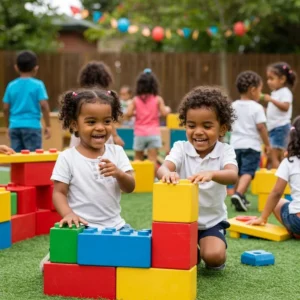
Chroma’s classrooms use cooperative building projects, group science investigations, and dramatic play scenarios to cultivate negotiation, shared planning, and conflict mediation. For example, a group building challenge may require children to assign roles, test structural ideas together, and revise plans after group reflection, teaching collaborative planning and resilience. Dramatic play setups invite role-taking and language-rich narration, while teacher strategies—such as modeling phrases for turn-taking and mediating disagreements—help children internalize social scripts. Observable outcomes include children initiating cooperative play, using polite negotiation language, and seeking peer input during problem-solving.
How Does Group Exploration Build Empathy and Communication?
Group exploration builds empathy by giving children concrete reasons to consider peers’ perspectives—sharing materials requires noticing others’ needs, and collaborative problem-solving invites alternative solutions. Language development accelerates through collaborative narration, as peers explain discoveries to one another and rehearse vocabulary introduced by educators. A classroom vignette shows children working on a shared gardening plot: one child suggests a watering schedule, another adapts it for plant needs, and through that exchange they practice compromise and begin to anticipate each other’s contributions. Parents can notice increased sharing, cooperative planning, and help-seeking behaviors as indicators of growing empathy and communicative competence.
How Does Inquiry-Based Learning Build Confidence, Independence, and Kindergarten Readiness?
Inquiry-based learning supports kindergarten readiness by strengthening self-regulation, independence, and early academic skills through scaffolded responsibilities and choice-driven routines. When children regularly make decisions, test strategies, and reflect on results, they develop confidence in their abilities and the self-reliance needed for classroom routines. Academically, inquiry promotes phonemic awareness, number sense, and problem-solving through playful investigations that map to kindergarten expectations, while socially it builds cooperative habits and emotional regulation. The table below compares readiness domains, showing how inquiry strategies translate into observable benefits that align with kindergarten readiness indicators.
The next paragraphs outline specific classroom routines and parental tips that encourage independence and readiness for the school environment.
What Strategies Empower Little Learners Toward Self-Reliance?
Teachers foster independence through classroom jobs, predictable schedules, and scaffolded tasks that increase in complexity as children mature, encouraging responsibility and confidence. Choice rotas let children select activities and practice decision-making, while classroom jobs—such as tidying a materials shelf—teach contribution and routine. Educators scaffold self-help skills by breaking tasks into manageable steps and prompting children with language that supports autonomy (e.g., “First you… then you…”). Parents can mirror these strategies at home by offering simple responsibilities, describing steps aloud, and celebrating effort to reinforce the same self-regulatory habits cultivated at school.
How Does Chroma Prepare Children Academically and Socially for Kindergarten?
Chroma’s PrismPath™ curriculum and GA Pre-K partnership align inquiry activities with literacy and numeracy goals using project-based approaches that embed phonemic awareness and number sense into meaningful contexts. For instance, circle-time investigations include letter-sound games tied to ongoing projects, while counting activities emerge naturally from measurement and building tasks, reinforcing mathematical concepts through real problems. Social routines—like cooperative circle time, peer-led projects, and transition practices—support classroom behaviors expected in kindergarten. These combined academic and social strategies provide a bridge between playful inquiry and the structured expectations of school, helping children enter kindergarten with confidence and foundational skills.
Why Should Parents Choose Chroma Early Learning Academy for Inquiry-Based Early Childhood Education?
Chroma Early Learning Academy integrates inquiry-based learning into a broader, research-informed model that balances five developmental pillars—physical, emotional, social, academic, and creative—so exploration supports whole-child outcomes. As a highly-rated daycare, childcare, and preschool operating across Metro Atlanta locations, Chroma is licensed, quality-rated, and partners with GA Pre-K to ensure state-aligned readiness. Teachers support inquiry with questions, materials and opportunities to revisit children’s ideas, while maintaining classroom routines and age-appropriate supervision. Below are concise unique value propositions families can expect when choosing Chroma for inquiry-driven early education.
- Holistic PrismPath™ approach that integrates five developmental pillars into daily inquiry.
- Licensed, quality-rated centers with GA Pre-K partnership and trained educators.
- Emphasis on safety, nutrition, and documented learning portfolios to track progress.
Families interested in inquiry-based preschool experiences at Chroma can inquire about program availability and schedule tours through the academy’s enrollment channels to see these practices in action.
What Unique Benefits Does the PrismPath™ Curriculum Offer Families?
PrismPath connects physical, emotional, social, academic and creative learning through purposeful play. Activities develop in complexity as children grow: early sensory exploration can lead to conversations, investigations and shared projects. Families can ask their child’s teacher what they are noticing and how classroom experiences support the next step in learning.
What can families look for during a campus visit?
Ask the teacher to walk you through a classroom activity: what sparked the children’s interest, what they tried and what they explored next. Look for opportunities for children to ask questions, use materials and share ideas. Discuss how the team communicates with families about learning and individual progress. A visit gives you a practical starting point for understanding the classroom experience.