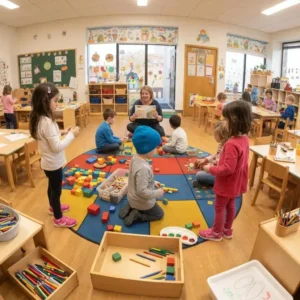
Kindergarten Readiness Made Easy
Getting a child ready for kindergarten means more than knowing letters and numbers; it’s about building the whole child so they can thrive socially, emotionally, and academically on day one. This article gives parents a practical kindergarten readiness checklist that links observable skills to everyday activities, explains local Georgia enrollment rules, and outlines programs that support readiness—so you’ll know what to look for and how to practice it at home. Many families worry about separation, whether their child knows enough letters, or how to foster independence; this guide addresses those pain points with specific signs, short at-home exercises, and school-aligned evidence. You’ll find clear definitions of core readiness domains, an explanation of how an intentional early-learning curriculum supports each skill, a Georgia-specific enrollment timeline, and hands-on activities parents can start immediately. The checklist maps each readiness area to simple parent actions and milestones, and the article highlights practical program options available through reputable providers in Metro Atlanta to help families connect strategy to local resources.
What Are the Key Kindergarten Readiness Skills Every Child Needs?
Kindergarten readiness is the combination of social-emotional, academic, motor, and self-help skills that enable a child to participate successfully in a classroom environment; these domains work together to support learning and independence. Social-emotional readiness allows a child to manage emotions and follow classroom routines, academic foundations provide the letters, sounds, and number sense teachers use to build instruction, motor skills support handwriting and play, and self-help skills let children manage belongings and simple tasks independently. Below is an easy-to-scan checklist of core domains with quick observable behaviors parents can watch for. This checklist focuses on what teachers typically expect during the first months of kindergarten and offers parents clear cues to measure progress and prioritize practice.
- Social-emotional: Follows simple directions, waits turns, uses words for feelings.
- Academic (early literacy): Recognizes some letters, enjoys shared reading, hears rhymes.
- Academic (early numeracy): Counts to 10, understands one-to-one correspondence, recognizes basic shapes.
- Motor skills: Holds a pencil with control, uses scissors safely, runs and climbs confidently.
- Self-help: Manages coat and backpack, opens snacks, uses bathroom independently.
Parents can use this list to spot gaps and select targeted activities; the next section explains how to encourage social-emotional growth at home and in play.
Which Social-Emotional Skills Support Kindergarten Success?
Social-emotional skills include emotional regulation, sharing, listening, cooperation, and following routines, and they directly affect how a child engages with peers and teachers. Emotional regulation enables a child to move from excitement to calm and participate in group learning; cooperation and sharing support group activities and reduce conflicts during transitions. To cultivate these skills, parents can use simple routines—like a brief “feelings check-in” at breakfast, role-play turn-taking with toys, and structured playdates that practice sharing and waiting. Observing a child who can wait a short time for a turn, ask for help, and settle after minor frustrations suggests readiness in this domain and points to targeted next steps if gaps appear. Building social-emotional skills also supports academic focus, so practicing emotional language prepares children for classroom learning.
What Academic Foundations Should Your Child Have Before Kindergarten?
Academic readiness centers on early literacy—books, letters, and sounds—and early numeracy—counting, patterns, and quantity recognition—which together give children tools teachers use to teach reading and math. A child familiar with several letters, able to name some letter sounds, counting reliably to ten, and recognizing basic shapes is positioned to access kindergarten instruction more easily; mastery is not required, but familiarity reduces early frustration. Parents can boost these foundations with daily read-alouds that highlight letters and rhyme, counting routines during snack or laundry, and quick games that sort objects by shape or color. Teachers assess these skills informally in the first weeks, so seeing increasing attempts to name letters or count objects indicates progress and readiness to build on classroom instruction. Strengthening these foundations at home creates confidence that supports the child’s transition to formal learning.
How Does Chroma Early Learning Academy’s PrismPath™ Curriculum Build Kindergarten Readiness?
PrismPath™ is Chroma Early Learning Academy’s proprietary learning model designed to develop the five pillars of early growth—social, emotional, physical, academic, and creative development—so children enter kindergarten with the confidence and skills teachers expect. The curriculum intentionally sequences play-based experiences and teacher-led moments to build target skills such as turn-taking, phonemic awareness, counting routines, and fine motor control that directly map to kindergarten expectations. Chroma’s approach pairs intentional classroom activities with ongoing teacher professional development and state-certified educators to ensure consistent implementation and measurable progress in readiness domains. Below is a curriculum mapping table that shows how PrismPath™ pillars connect to observable kindergarten skills and classroom examples that parents can recognize during visits or inquire about during enrollment conversations.
This table shows how PrismPath™ aligns classroom practice to readiness outcomes parents value, and it helps families identify concrete activities to look for when touring programs. Understanding how a curriculum maps to readiness skills makes it easier for parents to choose programs that intentionally prepare children for kindergarten.
How Does PrismPath™ Foster Holistic Development Through Play?
PrismPath™ uses play as the vehicle for instruction by embedding learning objectives into child-led and teacher-guided activities, which blend exploration with skill scaffolding. For example, dramatic play builds language and social negotiation as children create stories and assign roles; block play advances spatial reasoning and early math language when teachers introduce counting challenges or shape vocabulary. Teachers intentionally observe play, ask guiding questions, and model targeted language—this assessment-as-teaching loop accelerates skill gains while keeping activities engaging and age-appropriate. At home, parents can mirror this approach by following the child’s lead, adding one focused objective per play session, and narrating specific skills like counting or describing actions to reinforce academic connections. Play-based learning preserves child motivation while delivering the structured practice needed for kindergarten readiness.
What Kindergarten Prep Programs Does Chroma Offer for Ages 3 to 5?
Chroma’s primary program alignments for kindergarten readiness include Pre-K Prep for younger three- and four-year-olds and Pre-K / GA Pre-K for children in the typical prekindergarten age range; both are structured to progress skills across the PrismPath™ pillars. Pre-K Prep focuses on foundational habits—listening, simple routines, and early concept exposure—while Pre-K / GA Pre-K emphasizes school-readiness standards like phonemic awareness and classroom independence aligned to state guidelines. Many Chroma locations participate in GA Pre-K partnerships, offering families a familiar pathway into kindergarten programming in Metro Atlanta. Parents choosing a program should ask about classroom routines, daily literacy and math moments, and how teachers report progress toward readiness milestones; these components indicate a program’s focus on measurable kindergarten outcomes.
Chroma’s Prismpath™ Curriculum: A Blueprint for Kindergarten Readiness
Georgia Pre-K is a state-funded program designed to promote school readiness through standards-based early learning experiences; participation is often available through community providers who meet state quality criteria. The program emphasizes foundational skills and school routines consistent with Georgia Early Learning and Development Standards (GELDS), which guide classroom learning objectives for early literacy, numeracy, and social-emotional growth. For Metro Atlanta families, understanding the eligibility, enrollment timeline, and how community providers like some Chroma locations participate makes planning simpler and helps secure a spot in a quality program. The table below summarizes program types, typical eligibility, and practical timeline notes to help parents prepare applications and align family schedules.
- Key local actions: Gather proof of age, residency and immunization records as required by districts and programs.
- When to apply: Watch local enrollment windows; districts and providers often publish timeline updates each year.
- How to choose: Compare program alignment to GELDS, staff qualifications, and classroom routines when selecting a site.
Parents should confirm specific dates with their local district or provider and plan to apply early; the next subsection gives the short, factual age-cutoff rule most Georgia districts use.
What Is the Age Cutoff and Enrollment Timeline for Kindergarten in Georgia?
Georgia’s general kindergarten age cutoff is that children must be five years old on or before September 1 of the school year to enroll in kindergarten, though families should verify district-specific exceptions and exact dates. Typical enrollment timelines include spring or summer registration windows for public schools and rolling or set enrollment periods for private and community providers; parents should confirm their school system’s calendar well before summer. Required documents commonly include a birth certificate, immunization records, and proof of residence—collecting these early speeds registration and prevents delays. Checking district guidance and starting registration activities several months in advance reduces last-minute stress and ensures opportunities for program selection and orientation.
This table clarifies eligibility distinctions and stresses checking local timelines to secure the right placement.
How Does the GA Pre-K Program at Chroma Prepare Children for Kindergarten?
When Chroma implements GA Pre-K components, teachers align classroom routines and lessons to Georgia’s standards—focusing on language-rich interactions, daily counting routines, and social skill scaffolding that research links to successful kindergarten transitions. Chroma’s use of the PrismPath™ model pairs state standards with intentional play and assessment, so children practice school-style routines such as group circle time, turn-taking, and focused literacy moments. Parents enrolling in GA Pre-K at participating Chroma locations can expect documentation of developmental progress and teacher communication to guide home support. Families should check local Chroma sites for GA Pre-K participation and availability; aligning program selection with state standards helps ensure that classroom experiences build directly toward kindergarten expectations.
Which Practical Kindergarten Prep Activities Can Parents Do at Home?
Parents can accelerate readiness with short, daily activities that embed learning into routines rather than adding long practice sessions; consistent, playful practice yields measurable gains in the skills teachers value. Effective at-home activities are brief, focused, and repetitive—read-alouds that highlight a letter each night, counting steps or snack items, and short turn-taking games that teach patience and conversation skills. Below are practical, easy-to-implement ideas that fit busy family schedules and support multiple readiness domains simultaneously.
- Read daily: Share a short book and point out letters, rhymes, and story sequence.
- Count and compare: Count snacks, set the table, or sort laundry by color and size.
- Practice routines: Do coat-and-backpack runs, zipper practice, and independent toileting drills.
These activities are quick to integrate and help children generalize classroom expectations to home life, which supports smoother transitions when school starts.
What Play-Based Learning Activities Boost Social and Emotional Skills?
Play-based activities that intentionally practice sharing, waiting, and emotional language build social competence and classroom readiness while keeping play fun and motivating for children. Structured games like “pass the puppet” teach turn-taking, while cooperative building projects (shared block structures) practice negotiation and joint attention; parents can scaffold play by introducing simple rules and prompting emotion words when conflicts arise. Short routines such as a “feelings check” or naming three things that made the child happy or sad that day builds vocabulary for emotions and reduces reactive behavior during transitions. Regular practice of these activities increases a child’s ability to stay calm, listen to instructions, and work with peers—skills teachers identify as crucial in the first weeks of kindergarten.
How Can Parents Support Early Literacy and Numeracy Development?
Supporting early literacy and numeracy involves embedding teachable moments into daily tasks and using playful repetition to strengthen neural connections for reading and math skills. Read-aloud routines that emphasize predictability, rhyme, and letter-sound relationships foster phonemic awareness, while number talk—counting steps, comparing quantities, and using words like more and less—builds core number sense. Parents can set brief daily goals such as naming three letters or counting to ten with objects and track progress with a simple sticker chart to celebrate milestones. If a child shows persistent difficulty with letter recognition or counting after regular playful practice, parents should consult their preschool teacher for targeted strategies or early support resources.
This table summarizes activities parents can rotate through the week to address multiple readiness domains efficiently.
How Can Parents Navigate the Transition From Preschool to Kindergarten Smoothly?
A smooth transition balances emotional preparation with practical independence skills; both reduce anxiety and help children focus on learning when school begins. Emotional strategies—visiting the school, reading social stories about the first day, and arranging brief practice drop-offs—help children predict what will happen and build confidence. Practical independence work—packing a snack, zipping coats, and managing simple toileting—gives children the tangible skills they’ll use every day at school. The next paragraphs provide stepwise practices parents can implement in the months and weeks before kindergarten to build independence and ease separation anxiety.
- Start 4–8 weeks out: Practice mornings, packing backpacks, and simple self-care tasks.
- Schedule short visit: If possible, walk the child around the school, see the classroom doorway, and meet staff briefly.
- Role-play first-day routines: Practice entering class, sitting in a circle, and asking the teacher for help.
Establishing routines and practicing small responsibilities help children feel capable and reduce tears at drop-off during the first weeks. pre-k prep
What Strategies Help Children Adjust Emotionally and Build Independence?
Begin emotional and independence work several weeks before school starts with short, consistent practices that build competence: role-play separations, practice short separations that grow longer, and celebrate successful separations to reinforce confidence. Teach and rehearse small responsibilities—putting on shoes, opening lunch containers, and identifying their possessions—so tasks students face at school feel familiar and manageable. Use calm language to coach through anxiety and name feelings; modeling a brief positive goodbye routine helps children internalize a predictable transition. If a child continues to struggle with separation or shows regression, consult the child’s preschool teacher for tailored strategies and collaborative supports.
How Can Establishing Routines Ease the Kindergarten Start?
Routines create predictability, which reduces stress and supports attention and regulation when school begins, so gradually shifting bedtimes, morning schedules, and practice drop-offs makes the transition smoother. Sample routines—consistent bedtime with a wind-down book, a morning checklist with dress, teeth, and backpack, and a brief pre-school practice run—give children a scaffold to build independence and reduce chaos on the first day. Practice runs—doing the morning routine at least once a week in the month before school—help reveal friction points parents can address early, such as shoe difficulties or snack-packing habits. Over time, these small habit changes free mental energy for learning in the classroom and help children enter kindergarten ready to engage.
Why Choose Chroma Early Learning Academy for Your Child’s Kindergarten Readiness?
Chroma Early Learning Academy positions its programs to support kindergarten readiness through a proprietary PrismPath™ curriculum, state-certified educators, and community-trusted operations—elements families often prioritize when selecting early education. The academy emphasizes a balanced approach that links play-based learning to measurable readiness outcomes, while many locations participate in GA Pre-K partnerships that align classroom practice to state standards. Operational trust signals include ongoing professional development for educators, attention to balanced meals, and secure facilities; parents also report strong satisfaction, reflected in a cited community rating that indicates positive family experiences. If families want a program that integrates play, assessment, and school-ready routines, touring local Chroma sites and discussing PrismPath™ implementation can clarify how classrooms will meet their child’s needs.
- Key value propositions: PrismPath™ alignment to readiness, GA Pre-K participation at many locations, certified staff and structured nutrition.
- What to ask on tours: How teachers measure readiness, sample daily schedules, snack and meal approaches, and how transition planning is communicated to families.
- Next step suggestion: Schedule a tour or request enrollment information for your preferred location to observe classroom routines and ask about GA Pre-K availability.
These points help parents compare providers with a readiness-focused lens and determine whether a program’s practice matches family priorities for kindergarten preparation.
What Do Parents Say About Chroma’s Impact on Kindergarten Preparation?
Parent feedback themes associated with Chroma—confidence in children’s social skills, observed academic growth, and smooth transitions into kindergarten—appear in community reviews and reflect common outcomes families seek from early education. While individual experiences vary, the reported trend emphasizes steady progress in communication, independence, and classroom behaviors that teachers value at kindergarten entry. Families evaluating providers should read review summaries, ask to see assessment samples, and request teacher examples of progress-to-date to align impressions with classroom practice. Observing classroom moments that mirror the skills in this checklist offers concrete evidence of a program’s impact on kindergarten readiness.
How Does Chroma Ensure Safety, Nutrition, and Expert Care?
Chroma highlights secure facilities, balanced meals, and state-certified educators as operational priorities that support a learning environment where children can focus on development and school readiness. Safety measures that reduce disruptions help children feel secure and practice routines, while balanced meals support physical growth and concentration for active learning days. Certified staff and ongoing professional development ensure teachers are prepared to implement curriculum intentionally and observe developmental milestones. When touring programs, parents should ask specific questions about nutrition policies, staff qualifications, and daily safety routines to see how operational practices support the learning experiences described in the PrismPath™ curriculum.
This article has covered core readiness domains, curriculum alignment, Georgia enrollment details, practical home activities, transition strategies, and points families can use when visiting local programs. Each section links observable behaviors to simple practices parents can implement now to help children enter kindergarten with confidence.