Quality After School Care in Decatur
After-school programs in Decatur, GA provide structured care, academic support, and enrichment that bridge the school day and family schedules while promoting social-emotional growth and safety. This guide explains what parents should look for in elementary aftercare, how program models work, and the practical logistics that matter most—transportation, homework help, daily routines, and staff qualifications. Readers will learn how typical programs structure an afternoon, the kinds of activities that support learning and confidence, and decision criteria for choosing quality providers in Decatur. The article also maps how accredited providers translate curriculum into measurable outcomes and what enrollment steps parents should expect when securing a spot. Finally, the guide highlights safety and transportation practices, outlines enrollment next steps, and explains where to find program transparency and quality indicators such as licensing and quality ratings—equipping Decatur families to compare options effectively.
What Are the Key Features of After School Programs in Decatur, GA?
After-school programs in Decatur typically combine supervised care with targeted academic support and rotating enrichment that keeps children engaged until pickup. These programs focus on reliable transportation from school, dedicated homework time with staff support, snack or meal service, and varied club-style activities that rotate weekly to cover arts, STEM, and physical play. High-quality programs also maintain clear staffing ratios, certified staff or educators, and secure facilities with consistent check-in/out procedures to protect children. Understanding these core features helps parents compare options and evaluate whether a program will reinforce classroom learning while meeting logistical needs.
The core features parents prioritize include transportation, academic help, enrichment, supervision, and meals; the list below summarizes these priorities and what to expect.
- Reliable transportation from local elementary schools is provided for safe transfers to the after-school site.
- Structured homework assistance ensures children complete assignments with adult guidance and focus.
- Club-style enrichment rotates through STEM, arts, movement, and social skills to broaden interests.
- Meals or snacks are served in family-style settings to support nutrition and social development.
These features map directly to what families seek; the next subsection details which age groups commonly participate in Decatur after-school care and how programs adapt by development stage.
Before the comparison table below, note that programs vary by length and frequency, but the attributes shown are widely used to evaluate offerings across providers.
This table highlights common elements that parents should confirm when comparing providers. Understanding these availability patterns leads naturally into how age groups are grouped and addressed in Decatur after-school programs.
Which Age Groups Does Decatur After School Care Serve?
Most after-school offerings in Decatur are organized around school-age brackets, commonly grouping children into early elementary and upper elementary sets to target developmentally appropriate activities. Programs labeled “Schoolagers” typically serve ages 5–12 and tailor expectations—younger schoolagers receive more structured adult-led activities and shorter independent work time, while older schoolagers get opportunities for peer collaboration, leadership, and project-based enrichment. Staff adapt homework help intensity, movement breaks, and club options based on age to maintain engagement and support skill growth. Understanding these age brackets helps parents align program choice with their child’s social and academic needs and prepares caregivers for appropriate communication about progress and behavior.
What Activities and Enrichment Opportunities Are Offered?
After-school enrichment in Decatur balances academics with creative, physical, and social activities that expand interests and build transferable skills outside the classroom. Typical activity categories include focused homework assistance, STEM exploration (basic coding, experiments), visual and performing arts, sports and movement, and social-emotional learning exercises that teach teamwork and conflict resolution. Seasonal camps and holiday programs provide concentrated enrichment days with themed projects and extended activity blocks to engage children during school breaks. These activity mixes reinforce classroom learning, increase curiosity, and create safe spaces for social growth, which prepares children for long-term academic and personal success.
How Does Chroma Early Learning Academy’s PrismPath™ Curriculum Enhance School Age Childcare in Decatur?
PrismPath™ is Chroma Early Learning Academy’s proprietary learning model designed to deliver holistic development across physical, cognitive, social, emotional, and creative domains for school-age children. The curriculum integrates developmentally appropriate activities with intentional routines—such as dedicated homework time, targeted small-group enrichment, and reflective social-emotional practice—that accelerate skill transfer back into the classroom. By organizing learning around multiple developmental pillars, PrismPath™ helps children consolidate academic gains, strengthen peer interactions, and build resilience. The next subsection breaks down the curriculum’s core pillars and provides concrete after-school activities that demonstrate how each pillar operates in practice.
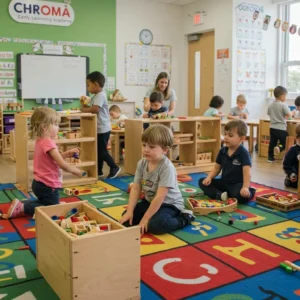
Chroma Early Learning Academy applies PrismPath™ to its Schoolagers program for ages 5–12, pairing state-certified educators with structured after-school routines that include transportation from local elementary schools, homework assistance, and club-style activities. Chroma’s model emphasizes family-style meals, monitored facilities, and open-door transparency, and the organization is described as licensed, Quality Rated, and a Georgia Pre-K partner—elements that support consistent implementation of PrismPath™ across locations. Chroma Early Learning Academy
What Are the Core Pillars of the PrismPath™ Curriculum for Schoolagers?
PrismPath™ is organized around several core pillars—academic reinforcement, social-emotional learning, physical development, and creative expression—to promote balanced growth in school-age children. Academic reinforcement includes supervised homework time and targeted mini-lessons to address common classroom challenges, while social-emotional activities use role-play and group problem-solving to build communication and self-regulation. Physical development comes through structured movement and outdoor play that support motor skills and focus, and creative expression is fostered by arts and project-based clubs that encourage experimentation and confidence. These pillars work together so that children practice skills in varied contexts, helping transfer learning to the classroom and everyday interactions.
How Does PrismPath™ Support Holistic Development and Kindergarten Readiness?
PrismPath™ supports holistic development by deliberately linking after-school routines to readiness markers—such as consistent homework completion, resilient peer interactions, and executive function tasks like planning and organization—that research associates with stronger school performance. By reinforcing classroom objectives through targeted homework assistance and small-group coaching, after-school sessions increase practice opportunities that lead to higher retention and confidence. The curriculum’s social-emotional components build self-awareness and collaboration skills that teachers often cite as predictors of long-term academic success. Evidence from contemporary educational practice shows that consistent out-of-school reinforcement of classroom skills accelerates readiness and sustained achievement, making holistic models like PrismPath™ valuable for school-age children.
What Transportation and Safety Measures Ensure Secure After School Care in Decatur?
Transportation and safety are foundational to trustworthy after-school programs in Decatur; secure pick-up routines, trained drivers/staff, and monitored facilities form the operational backbone of dependable care. Programs commonly operate scheduled pickup windows, maintain staff-to-child supervision ratios, and use explicit sign-in/out protocols to ensure accountability during transfers. Health and emergency protocols—such as illness screening, sanitized spaces, and emergency drill routines—reduce risk while providing families with predictable responses. Clear communication channels between program staff and families, along with transparent facility policies, further increase parental confidence in daily operations and incident response.
Below is a concise table comparing transportation and safety attributes parents should confirm when evaluating providers.
This table summarizes typical logistics; for specific current school lists or pickup windows, parents should request the provider’s up-to-date schedule. The following subsection addresses which Decatur elementary schools are usually served and practical steps if a school list is not publicly available.
Which Decatur Elementary Schools Are Served by Chroma’s Transportation?
Chroma Early Learning Academy provides transportation from local elementary schools to support reliable access to after-school care and reduce logistical burden for families. Exact school lists and pickup windows vary by location and season, so parents are advised to confirm the current roster when enrolling; program staff typically provide a clear pickup schedule and communication protocols for delays or changes. Drivers and transportation staff follow sign-out procedures that mirror on-site check-in systems, coordinating with site leaders to ensure safe handoffs. Confirming the schools served and the expected pickup window helps families plan afternoon logistics and confirms the program can serve their child’s school.
What Safety Protocols and Facility Features Protect Children?
High-quality after-school sites implement layered safety protocols: verified staff background checks, routine emergency drills, secure entry systems, and health hygiene practices to reduce illness transmission. Programs commonly require documented staff qualifications or certifications and ongoing training so adults are prepared for classroom support and emergency response alike. Check-in/out procedures typically include photo ID verification, authorized pick-up lists, and staff logs to prevent unauthorized departures. Facilities that offer open-door transparency and frequent parent communication further strengthen trust by allowing families to observe routines and confirm that safety protocols are consistently enforced.
How Can Parents Enroll and What Are the Fees for After School Programs in Decatur, GA?
Enrollment for after-school programs in Decatur follows a predictable process that balances documentation, orientation, and scheduling, while fees are typically structured in weekly, monthly, or per-session models. Parents usually complete an application, provide health and emergency contact information, and attend an orientation or introduction session before the child’s first day. Payment options vary across providers but commonly include recurring billing, deposits to hold a spot, and sibling discounts; exact fees should be requested directly from the program to reflect current rates. The steps below guide parents through a streamlined enrollment flow and explain typical payment arrangements so families can plan in advance.
The enrollment steps below outline the typical sequence parents should expect when securing after-care for elementary students.
- Submit Application: Complete program application and requested child information.
- Provide Health Records: Upload or deliver required health forms and emergency contacts.
- Schedule Orientation: Attend orientation or meet-the-staff session before the first day.
These steps outline the standard path to start care; the following table breaks down estimated timing and requirements for each enrollment step to help parents plan.
This table clarifies the administrative path; parents should contact the provider for exact fee schedules and to arrange tours or a start date. The next subsection covers the enrollment process specifics and where to request fee details.
What Is the Enrollment Process for Decatur After School Care?
The typical enrollment process begins with an application and collection of essential health and contact information, followed by an orientation or meet-and-greet with staff to review routines and policies. Programs may require a deposit or initial payment to hold a spot and will confirm start dates once documentation is complete. Orientation often includes an overview of daily schedules, homework support plans, and safety procedures so families understand how learning and supervision are structured. Scheduling a tour or site visit during orientation helps parents assess fit and ask operational questions about transportation, meals, and communication protocols.
What Are the Typical Fees and Payment Options?
Fee structures for Decatur after-school care commonly include weekly tuition, flat monthly rates, or per-day fees for drop-in or seasonal camp sessions; sibling discounts and bundled packages are also typical market options. Payment methods usually include recurring electronic payments with clear cancellation policies and occasional registration or activity fees for special programs. Because exact prices fluctuate by provider and location, parents should request a current fee schedule and inquire about financial assistance or sliding scale options if available. Confirming billing cycles, refund policies, and included services—such as meals or field trips—helps families compare true costs across programs.
What Do Parents Say About Decatur After School Enrichment and Care at Chroma?
Parents evaluating after-school options often look for transparent communication, observed developmental gains, and consistent safety practices; providers that publish quality ratings and curriculum frameworks make that evaluation simpler. Families commonly ask for references, request to observe routines, and seek measurable indicators such as quality ratings or accreditation that show consistent program standards. Chroma Early Learning Academy emphasizes open-door transparency, state-certified educators, family-style meals, and monitored facilities, and is described as licensed, Quality Rated, and a Georgia Pre-K partner—credentials parents can use to benchmark quality. The following subsection explains appropriate ways to assess social proof without relying on anecdotal quotes.
When assessing social proof, parents should request evidence of consistent program outcomes and view documented quality indicators rather than rely solely on testimonials.
Which Local Testimonials Highlight Program Benefits?
Rather than presenting specific quotes, a constructive approach is to ask providers for anonymized summaries of parent feedback and documented outcome measures that map to priorities like homework completion and social development. Providers may share aggregated survey results, retention rates, or program highlights that indicate satisfaction without naming individuals. Parents should ask for sample daily schedules, examples of enrichment projects, and observable indicators of progress during a tour. Requesting this evidence helps verify that advertised benefits—such as consistent homework support or engaging clubs—are realized in daily practice.
How Does Chroma Build Trust Through Transparency and Quality?
Chroma builds trust through several operational practices: open-door policies that allow parental observation, staffed programming by state-certified educators, display of accreditations such as Quality Rated status and Georgia Pre-K partnership, and routine communication about daily activities and incidents. These transparency measures allow families to verify the fidelity of curriculum implementation and safety protocols while staying informed about their child’s progress. Documented practices—like family-style meals and monitored facilities—reinforce daily structure and provide tangible evidence of quality. Asking providers for staff bios, curriculum overviews, and accreditation documentation during a tour is a practical next step for parents evaluating programs.
What Are Common Questions About After School Programs in Decatur, GA?
Parents commonly ask how after-school programs improve academic outcomes, what safety measures are in place, how transportation is managed, and how to choose the right program for their child’s needs. Addressing these concerns directly helps families narrow choices and schedule tours that surface meaningful differences across providers. The sections below summarize core benefits and provide a decision checklist to help parents compare programs objectively and prioritize the features that matter most.
What Are the Benefits of After School Programs for Elementary Students?
After-school programs offer structured homework support that improves completion rates, enrichment that sparks new interests, and social-emotional learning that enhances peer interaction and self-regulation. Regular participation increases practice opportunities for classroom skills, which contributes to improved retention and confidence in school tasks. Physical activities and arts engagement support overall wellbeing and reduce afternoon fatigue, while club rotations expose children to skills they might not encounter during the regular school day. These combined benefits translate into stronger school performance, greater engagement, and improved readiness for successive grades.
How Do I Choose the Right After School Program in Decatur?
Choosing the right program requires a checklist that aligns safety, curriculum quality, staff credentials, logistics, and cost with family priorities. Visit sites, observe routines, confirm transportation options and pickup windows, review curriculum goals and daily schedules, and verify staff qualifications and accreditation. Ask specific questions about homework support, enrichment rotations, health and emergency procedures, and how the program communicates with families. Use a simple scoring method—rate each domain on a 1–5 scale—and prioritize top-scoring programs for tours and trial days to make a confident selection.
- Safety and supervision: Verify background checks and check-in/out procedures.
- Curriculum and enrichment: Confirm structured homework time and rotating clubs.
- Logistics and transportation: Ensure pickup from your child’s elementary school.
- Cost and policies: Review billing cycles, deposits, and included services.
Using this checklist during visits enables direct comparisons across options; the next practical step is to schedule a tour and confirm enrollment timelines.