Chroma Academy: Childcare FAQs & Schedule
Chroma Early Learning Academy provides a transparent guide for families seeking clear expectations about daily rhythms, policies, safety protocols, communication channels, and curriculum so parents can make informed decisions. This page explains daily schedules by age, essential enrollment and operational policies, health and safety rules, parent communication practices, and how the PrismPath™ curriculum shapes learning outcomes. Many parents feel uncertain about how a typical day will support their child’s development; this FAQ-style hub reduces that uncertainty by outlining routines, required actions, and what to expect from staff and programs. The article will walk through age-group schedules, enrollment and daily policies, health and safety procedures, parent communication tools, a detailed description of the PrismPath™ learning model, and where to find downloadable resources and help. Throughout, you’ll find practical checklists, comparison tables, and short how-to lists designed to be scannable and actionable for busy caregivers.
What are the key daily schedules for each age group at Chroma Early Learning Academy?
A daily schedule aligns predictable dayparts—arrival, learning blocks, meals, outdoor play, rest, and departure—with age-appropriate learning and wellbeing objectives so children thrive physically and emotionally. Predictable routines reduce stress, support transitions, and create repeated learning opportunities where teachers apply targeted activities that reinforce social, cognitive, and motor development. Below is a compact comparison that clarifies how the day is structured across age bands to balance caregiving tasks and guided learning. After this overview, the following subsections describe infant nurturing routines and the structured rhythms used for toddlers and preschoolers so can match expectations to home routines.
The table below offers a quick, scannable comparison of typical dayparts and goals by .
This comparison demonstrates how each age band prioritizes different developmental targets while preserving consistent dayparts that ease transitions and reinforce learning throughout the day. The predictable daily structure supports both teachers’ planning and families’ routines, and it naturally integrates the PrismPath™ approach described later in the article. If you want to see the schedule in person, schedule a tour with to observe how daily rhythms are implemented in classrooms.
How does the infant daily routine support nurturing and sensory discovery?
Infant daily routines center on responsive caregiving: individualized feeding and diapering, short restorative naps, sensory exploration, and calm transitions that support attachment and physiological regulation. Caregivers follow each infant’s home routine where possible, using consistent rituals—greeting, feeding, play, and comfort—that create predictability and strengthen caregiver-child bonds. Sensory discovery activities include safe tactile materials, visual tracking, gentle music, and supervised tummy time to encourage motor milestones and early sensory integration. These approaches pair with frequent, documented communication to families about feedings, naps, and so progress and preferences remain coordinated between home and the academy.
Daily infant timelines balance stimulation and rest to protect neurological development and sleep consolidation; this balance leads to smoother transitions into toddler routines. The infant routine’s predictable pattern of soothing and brief activities supports sensory learning and prepares infants for more structured group experiences later in the .
What activities structure toddler and preschool daily rhythms?
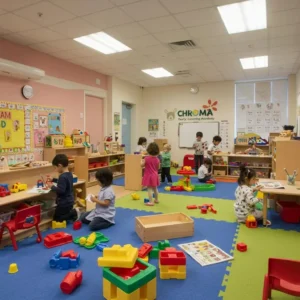
Toddlers and preschoolers follow rhythms that alternate teacher-directed experiences and child-initiated play, using short focused learning blocks, learning centers, songs, outdoor play, and rest or quiet time to scaffold self-regulation and exploratory learning. Guided activities emphasize language, early numeracy, sensory projects, and imitation games, while learning centers provide repetition and choice that build autonomy and concentration. Gross motor time outdoors is scheduled daily to support coordination and vestibular development, and snack/meal times are used as social learning opportunities for manners and communication. Transitions use cues—songs, visual timers, and consistent phrases—to reduce friction and promote predictable behavior.
This structured alternation between guided instruction and choice-based play supports developmental goals and sets expectations for independent participation; transitions practiced here become the foundation for school-readiness skills that are expanded in .
What Are Chroma Academy's Daily Schedules for Each Age Group?
Essential policies create a shared operational framework covering enrollment and admissions mechanics, tuition expectations, behavior guidance, dress and personal items, field trip permissions, and withdrawal procedures so families understand responsibilities and logistics. Clear written policies reduce misunderstandings and help families plan for onboarding, daily drop-off, and emergency contingencies. The subsection below outlines the stepwise registration and tuition overview routinely ask about, followed by practical guidance on daily operational policies such as clothing, belongings, and permissions.
Parents will find that concise, transparent policy explanations make registration smoother and daily operations more predictable; the next subsection explains registration steps in practical .
How do enrollment and admissions policies guide registration and tuition?
Enrollment begins with registration, required forms, and any orientation or trial visits; the academy manages waitlists and secures placements using deposits and tuition agreements to hold spots. Parents are asked to complete health and authorization forms and to review the so family expectations align with academy practices. The payment cadence typically involves monthly tuition with clear deadlines and documented withdrawal notice requirements; GA Pre-K participation, where applicable, is coordinated according to state guidance and program eligibility. These steps ensure that families and staff share expectations about enrollment logistics before the child’s first day.
- Complete registration and required health/consent forms to initiate admission.
- Confirm placement with deposit and sign the tuition agreement to reserve the spot.
- Attend orientation or scheduled tours so families understand daily routines and expectations.
These numbered steps serve as a quick checklist for parents preparing to enroll; the next subsection outlines daily operational what children bring and how behavior guidance is handled.
What general academy policies affect daily operations and child care?
Daily operational policies address clothing, personal items, behavior guidance, field trip consent, and visitation to maintain safety and instructional continuity during the day. Parents are advised to send weather-appropriate, labeled clothing and to limit toys from home unless approved for comfort items, which helps reduce loss and classroom distractions. The academy’s behavior guidance centers on positive reinforcement, redirection, and developmentally appropriate interventions that teach skills rather than punitive responses. Field trip permissions require prior consent and typically specify transportation arrangements and emergency contact information, while visitation guidelines protect classroom routines while welcoming family engagement through scheduled conferences and limited, supervised
- Clothing and belongings guidance helps maintain safety and classroom focus.
- Behavior guidance emphasizes teaching social skills and emotional regulation.
- Field trip and visitation policies balance family involvement with classroom stability.
These operational policies work together to create a predictable environment; the following section focuses specifically on procedures that protect daily wellbeing.
How does Chroma Early Learning Academy ensure child health and safety?
Health and safety protocols combine symptom-based exclusion rules, formal medication administration procedures, allergy management plans, emergency preparedness drills, and access-control practices to minimize risk and respond quickly when incidents occur. Clear policies define parent responsibilities for reporting illnesses, required documentation for medications, and the academy’s procedures for safely. The subsections below provide a rapid sick-child checklist and medication process, and then outline drills, secure entry, and authorized pickup policies so families know how emergencies are handled and how communication will proceed.
The table below compares key policies, who they apply to, and the corresponding and academy actions to ensure transparency and shared responsibility.
This policy comparison clarifies responsibilities and helps families understand expectations in common scenarios; the next subsection presents a concise sick-child checklist and medication steps designed for quick .
What is the sick child policy and medication administration procedure?
The sick child policy lists specific exclusion symptoms—fever, uncontrolled vomiting, persistent diarrhea, undiagnosed rash, and contagious conditions—and defines return criteria such as being fever-free for at least 24 hours without fever-reducing medication. Parents must report communicable illnesses promptly so staff can monitor exposures and notify other families as appropriate, protecting community health. Medication administration requires a signed authorization form from the parent with clear dosing instructions; staff store medications securely, log every dose given, and follow training protocols for safe administration. In case of uncertainty, staff consult established and contact the parent for immediate decisions.
- Fever, vomiting, diarrhea, severe rash, or persistent behavioral changes are reasons for exclusion.
- Return requires symptom resolution and adherence to the academy’s documented return criteria.
- Medication is administered only with a signed authorization, secure storage, and documented dosing.
This concise checklist and procedural summary helps parents prepare before an illness occurs; the following subsection describes emergency drills and security measures the to maintain safety.
How are emergency procedures and facility security measures implemented?
Emergency procedures include frequent drills for fire, severe weather, and lockdown scenarios, staff training in emergency response, clear evacuation plans, and workflows to ensure timely updates. Access control typically involves secure entry points, staff verification of authorized caregivers, and strict pickup policies to confirm identity and authorization before releasing a child. During any critical event, staff prioritize immediate safety, execute the practiced drill procedures, and then notify parents through established communication channels with clear next steps. The academy also maintains individual emergency plans for children with medical needs, ensuring staff can implement personalized responses rapidly.
- Routine drills prepare staff and children for predictable responses.
- Access-control and authorized pickup policies reduce unauthorized entry risks.
- Parent notification follows a clear workflow to provide accurate, timely information.
These procedures create layered protection that combines prevention, practice, and rapid communication; the next main section focuses on everyday and how the academy shares daily updates.
How does parent communication work at Chroma Early Learning Academy?
Parent communication at the academy uses a multi-channel cadence to deliver daily updates, incident notifications, developmental reports, and scheduling information so families stay connected to their child’s progress and classroom life. Regular touchpoints include daily reports, photo and activity sharing, scheduled conferences, and an open but structured visitation policy that respects classroom routines. Clear escalation pathways enable parents to provide feedback or raise concerns and expect timely responses from teachers and leadership. The subsections below highlight the that enable most daily updates and explain how conferences and open-door practices preserve partnership and classroom stability.
What features does the Chroma Parent App offer for daily updates?
The Chroma Parent App consolidates daily reports, photos of activities, secure messaging, meal and nap logs, and emergency alerts so families receive a comprehensive snapshot of each day. Photo and activity sharing gives parents visual context for learning moments, messaging allows direct teacher communication, and daily logs summarize feeding, sleep, and toileting for younger children. Emergency alerts ensure rapid parent notification when incidents occur or when closures are necessary, and the app’s messaging supports scheduling conferences and sharing documentation. This continuous digital connection reduces uncertainty at drop-off and pickup and reinforces partnership between families and .
- Photos and activity sharing provide visual learning evidence.
- Secure messaging enables direct, documented conversations with teachers.
- Daily meal and nap logs keep families informed of basic care routines.
How are teacher-parent conferences and open door policies conducted?
Teacher-parent conferences are scheduled regularly and focus on developmental milestones, individualized goals, assessment summaries, and strategies families can use at home to reinforce learning. Conferences typically follow an agenda—progress highlights, observed strengths, areas for growth, and collaborative next steps—so meetings are productive and outcome-oriented. Open-door practices encourage family involvement while balancing classroom stability by requiring brief, scheduled visits or guided observation windows that minimize disruption to routines. Parents are encouraged to prepare questions and to share updates from home that inform individualized and learning goals.
- Conferences are agenda-driven and scheduled to allow focused discussion.
- Open-door visits are coordinated to protect learning time and classroom rhythm.
- Parents receive written summaries of conference outcomes via the app or written reports.
These combined communication practices—digital updates plus structured in-person conversations—ensure families remain informed and engaged; the next major section explains how the shapes daily learning.
What is the PrismPath™ curriculum and how does it shape learning experiences?
PrismPath™ is Chroma’s learning model that maps daily activities to five development pillars—physical, emotional, social, academic, and creative—so that each day intentionally advances multiple domains of development. The curriculum uses integrated lesson planning where a single activity contributes to several pillars at once; for example, a music and movement period can strengthen physical coordination (physical), turn-taking (social), expressive language (academic), and emotional regulation (emotional). Assessments, progress documentation, and classroom portfolios feed back into teacher planning and parent reporting so goals remain transparent and measurable. The subsections below include a mapping table that shows concrete daily activities linked to each pillar and an explanation of age-specific learning goals and assessment methods.
Below is a mapping that illustrates how the PrismPath™ translate into daily classroom activities across age groups.
This pillar mapping shows how multi-domain activities deliver richer developmental outcomes rather than isolated skill drills; the next subsection explains assessment cadence and age-specific goals so parents know to expect.
How does the PrismPath™ curriculum address the five pillars of development?
Each PrismPath™ pillar targets a core domain and is practiced through daily, age-adapted activities so children experience holistic development in context. For physical development, teachers plan gross motor blocks and fine-motor table tasks; for emotional development, consistent routines and emotion coaching support regulation; for social development, structured peer interactions teach cooperation and perspective-taking; for academic development, scaffolded literacy and numeracy experiences build foundational skills; and for creative development, open-ended art and music foster imagination. Teachers document observations and use brief assessments to adjust instruction and to communicate progress to families through and conferences.
- Physical: balance and coordination through outdoor challenges.
- Emotional: predictable caregiving and labeling feelings to build self-regulation.
- Social: guided peer interactions to practice sharing and cooperation.
- Academic: small-group lessons that target pre-literacy and numeric concepts.
- Creative: explorative art and dramatic play that stimulate expression.
This integrated pillar approach ensures daily activities serve multiple learning outcomes, and it links directly to the and assessment methods described next.
What are the age-specific learning goals and assessment methods?
Age-specific goals define realistic, developmentally-appropriate milestones for infants, toddlers, preschoolers, pre-K, and school-age children, and staff use observational checklists, portfolios of work, and periodic progress summaries to document growth. Infants are tracked for social attachment, motor milestones, and sensory responsiveness; toddlers are measured on language bursts, self-help skills, and simple social exchanges; preschool and pre-K children have benchmarks for early literacy, numeric recognition, fine motor control, and cooperative play that align with school-readiness targets. Assessments are ongoing and formative—teachers collect samples of work, record observations, and share progress through the and scheduled conferences on a regular cadence.
- Observational notes and portfolios form the primary assessment artifacts.
- Teachers use short-cycle planning to adjust daily activities based on assessment data.
- Parents receive periodic summaries and can review work samples during conferences or via the app.
These assessment methods keep families informed and make developmental progress transparent, supporting targeted learning at each age band; the next section points parents toward and how to navigate them.
Where can parents find detailed FAQs and resources about daily operations and policies?
A centralized – Policies and FAQs hub contains the academy’s parent handbook, policy PDFs, medication authorization forms, safety videos, and procedural walk-throughs so families can find authoritative answers and downloadable documents in one place. This resource hub is organized into sections—Enrollment, Health & Safety, Communication, Curriculum—so parents can quickly locate the documents or videos they need and prepare for enrollment and day-to-day participation. The subsections below explain how to navigate the hub and list downloadable items and videos that address common questions.
Providing a clear reduces repeated questions, ensures consistent policy application, and makes onboarding faster; next we explain how to use the hub efficiently.
How to use the Parents – Policies and FAQs hub for comprehensive guidance?
The hub is organized by topic area and contains a searchable table of contents, categorized PDFs such as the parent handbook and medication forms, and short explainer videos for key policies, enabling families to find specific items quickly. Parents should begin by reviewing the sections, downloading required forms, and noting any orientation or documentation deadlines. The hub also provides guidance on where to submit completed forms and how to request individualized care plans for allergies or medical needs. For additional help, the hub indicates how to schedule a tour or contact leadership for clarifying questions.
- Start with Enrollment and Health & Safety sections to complete required paperwork.
- Use the search or table of contents to find specific policy PDFs.
- Request individualized plans or schedule a tour through the hub’s contact options.
This navigation approach helps families complete onboarding efficiently and prepares them for consistent daily .
What downloadable resources and videos explain key policies?
Recommended downloadable items include the parent handbook PDF, medication authorization form, allergy and care-plan templates, and field trip consent forms; short video topics often cover security walkthroughs, a sick-child policy overview, and how daily reports are generated. Each downloadable file has clear filenames and alt text that describe contents for easy retrieval, and videos are brief—typically under five minutes—so parents can quickly understand procedures without disrupting their schedules. The hub also suggests naming conventions and where to store completed forms until submission, making file management straightforward for busy families.
- Parent handbook PDF and medication authorization form for required documentation.
- Allergy care-plan template and field trip consent forms for permissions and safety.
- Short explainer videos on security, sick-child policy, and app usage for quick orientation.
These resources enable families to access and visual demonstrations that clarify expectations and procedures, and they link back to opportunities to schedule tours or speak with staff about specific needs.
Frequently Asked Questions
What should parents know about the transition from infant to toddler care?
The transition from infant to toddler care at Chroma Early Learning Academy is designed to be smooth and supportive. As children grow, their daily routines shift to include more structured activities and opportunities for social interaction. Parents can expect an increase in guided play and language development activities, which are essential for toddlers. The academy encourages parents to maintain open communication with caregivers to ensure that the transition aligns with the child’s individual needs and home routines, fostering a sense of security and continuity.
How does Chroma Academy support children with special needs?
Chroma Early Learning Academy is committed to inclusivity and provides tailored support for children with special needs. The academy collaborates with families to create individualized care plans that address specific developmental goals and accommodations. Staff members receive training in recognizing and responding to diverse learning needs, ensuring that all children can participate in activities. Regular assessments and open communication with parents help track progress and adjust strategies as necessary, promoting a nurturing environment where every child can thrive.
What are the benefits of the PrismPath™ curriculum for child development?
The PrismPath™ curriculum at Chroma Academy is designed to foster holistic development across five key pillars: physical, emotional, social, academic, and creative. By integrating activities that target multiple domains, children experience richer learning outcomes. For instance, a music session not only enhances physical coordination but also supports emotional expression and social interaction. This comprehensive approach ensures that children are well-prepared for future educational challenges while developing essential life skills in a supportive environment.
How does the academy handle behavioral issues among children?
Chroma Early Learning Academy employs a positive behavior guidance approach to address behavioral issues. Instead of punitive measures, staff focus on teaching children appropriate social skills and emotional regulation through redirection and positive reinforcement. When challenges arise, caregivers work closely with children to understand the underlying causes and provide constructive feedback. This method not only helps children learn from their experiences but also fosters a supportive community where they feel safe and understood.
What resources are available for parents to support learning at home?
Chroma Academy provides various resources to help parents support their child’s learning at home. The academy offers access to educational materials, activity suggestions, and developmental milestones through the Chroma Parent App. Additionally, regular teacher-parent conferences provide insights into the child’s progress and strategies for reinforcing learning at home. Parents are encouraged to engage in activities that align with the PrismPath™ curriculum, ensuring a consistent learning experience that bridges the gap between home and the academy.
How can parents get involved in their child’s education at Chroma Academy?
Parents are encouraged to actively participate in their child’s education at Chroma Academy through various avenues. The academy hosts regular events, workshops, and family engagement activities that foster community involvement. Parents can also volunteer for classroom activities or field trips, providing valuable support and enhancing their child’s learning experience. Open-door policies allow parents to visit and observe classroom dynamics, ensuring they remain connected to their child’s educational journey and fostering a strong partnership with educators.