Fostering Problem-Solving Skills in Preschoolers: Effective Activities and Critical Thinking Development
Problem-solving skills in preschoolers refer to a child’s emerging ability to identify simple problems, generate solutions, test those ideas, and adjust behavior based on outcomes; developing these skills early lays the groundwork for reasoning, self-regulation, and kindergarten readiness. Early logic skills and critical thinking kids need are built through a mix of play-based learning critical thinking opportunities, scaffolded adult guidance, and progressively complex tasks that encourage planning and persistence. This article explains how educators and parents can intentionally use puzzles, multi-step projects, pattern recognition sequencing preschool activities, and role-play to nurture decision-making and flexible thinking. You will learn classroom strategies, proven activity types, specific at-home games, milestone cues to track progress, and how Pre-K logic development connects to literacy and math readiness. Practical lists, two comparison tables, and classroom-to-home transitions make the guidance actionable for caregivers and educators seeking measurable ways to support child problem solving.
Building Preschoolers' Problem-Solving Skills & Critical Thinking
Problem solving at Chroma Early Learning Academy centers on structured play, guided discovery, and curriculum-aligned experiences that activate reasoning and persistence in young learners. The approach combines play-based problem-solving activities with intentional teacher scaffolding so children practice hypothesis-testing, sequencing, and choice-making during everyday routines. Educators model open-ended questioning and prompt children to verbalize plans, which strengthens executive function and task persistence. The next paragraphs describe the academy’s curriculum architecture and educator practices that translate theory into classroom routines.
What Is the PrismPath™ Curriculum and Its Role in Critical Thinking?
PrismPath™ is Chroma’s proprietary curriculum organized around five pillars that collectively promote cognitive, social, and creative development while explicitly supporting logic and multi-step projects. Each pillar targets specific skill clusters—such as pattern recognition, language for reasoning, and hands-on exploration—which teachers map to preschool problem solving activities when planning daily learning rhythms. For example, a pillar emphasizing creative exploration uses open-ended materials for block challenges that develop spatial reasoning; a pillar focused on emergent math builds sequencing and pattern tasks preparing children for kindergarten readiness problem solving. These pillar-to-activity links show how curriculum design intentionally scaffolds early logic skills.
How Do State-Certified Educators Foster Logic and Decision-Making?
State-certified educators at Chroma use a set of classroom practices—scaffolding, modeling, and reflective questioning—to support decision-making and focused problem solving in preschoolers. Teachers set up provocations with progressively difficult choices, observe children’s strategies, and offer targeted prompts that stretch thinking without rescuing the child from productive struggle. Classroom routines—such as shared project planning and rotational learning centers—embed opportunities for choice and sequencing that strengthen executive function. These educator practices ensure that children move from guided to more independent problem solving, and they create frequent teacher-to-parent touchpoints describing observed progress.
What Are the Best Preschool Problem Solving Activities to Encourage Critical Thinking?
Preschool problem solving activities are developmentally appropriate tasks that challenge children to plan, test ideas, and reflect, and they work by giving repeated, scaffolded practice in reasoning under low-stakes conditions. High-quality activities combine manipulatives, social negotiation, and predictable routines so children internalize sequencing, cause-and-effect, and strategy use. The list below prioritizes activity types that consistently produce gains in spatial reasoning, sequencing, and collaborative reasoning across preschool classrooms and home settings.
- Play-based learning activities encourage experimentation and symbolic thought through open materials.
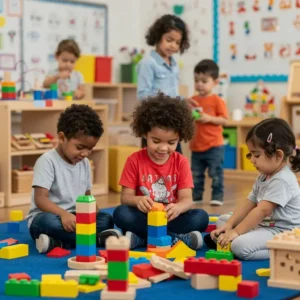
- Puzzles and building blocks develop spatial reasoning and iterative testing.
- Role-playing and puppetry foster perspective-taking and planning.
- Simple STEAM experiments introduce hypothesis testing and controlled observation.
These activity types translate directly into observable outcomes such as improved task persistence, clearer planning language, and smoother sharing during collaborative tasks.
How Do Play-Based Learning Activities Enhance Early Logic Development?
Play-based learning critical thinking opportunities let children experiment with materials, test ideas, and learn from outcomes in an intrinsically motivating context. Activities like water play with measuring cups, sandbox construction, and open-ended art let children propose a solution, observe results, and refine their approach—practicing the scientific method in miniature. Teachers scaffold by asking predictive questions and suggesting minor modifications, helping children build sequencing and cause-effect reasoning. Home adaptations include open-ended trays and loose parts that invite experimentation and support continuous skill transfer between school and home.
Which Puzzles, Building Blocks, and Role-Playing Games Promote Problem Solving?
Specific logic games for preschoolers—shape sorters, simple jigsaws, graduated block challenges, and puppet-based scenario play—advance predictable skill progressions from single-step matching to multi-step planning. For instance, a 6–12 piece jigsaw builds persistence and visual discrimination, while block challenges that ask a child to replicate a pattern develop spatial language and sequencing. Scaffolding moves include modeling a strategy, breaking tasks into steps, and prompting reflection after attempts. Teachers and parents can use assessment cues—verbal planning, fewer random attempts, and longer task engagement—to monitor improvement.
How Is Early Childhood Logic Development Integrated into Pre-K Prep Programs?
Pre-K logic development intentionally escalates task complexity so children move from teacher-guided activities to independent multi-step projects that align with emergent literacy and math skills. Integration emphasizes sequencing, pattern recognition, and symbolic representation as foundations for kindergarten readiness problem solving. Project-based learning in Pre-K Prep ties small experiments to story retelling, counting routines, and collaborative design tasks that require planning and role division. The following table compares typical multi-step project components with targeted skills and expected outcomes to clarify implementation choices for educators and parents.
What Are Multi-Step Projects and Their Benefits for Preschoolers?
Multi-step projects in a preschool curriculum include tasks where children must plan, execute, and reflect on sequences of actions—such as building a bridge in stages or following a recipe over multiple sessions. These projects build executive function by requiring working memory, inhibitory control, and cognitive flexibility; children learn to anticipate consequences and adjust strategies when a first attempt fails. Sample classroom outlines might break a project into planning, prototype, testing, and revision phases with roles for small groups, which mirrors real-world problem solving and strengthens collaboration skills.
How Does Pattern Recognition and Sequencing Support Reasoning Skills?
Pattern recognition and sequencing are cognitive skills that enable children to identify regularities, predict outcomes, and create ordered representations—abilities that underpin both early math and emergent literacy. Classroom activities like clapping patterns, bead sequencing, and rhythm chants reinforce the same neural processes used in algebraic thinking and sentence structure. Teachers scaffold by asking children to extend patterns and describe rules aloud, which develops rule-based reasoning and verbal sequencing. Observable progress includes faster pattern completion, self-correction, and use of causal language when explaining sequences.
Why Is Fostering Critical Thinking Important for Young Children’s Growth?
Fostering critical thinking in early childhood yields measurable cognitive, social, and emotional benefits that support long-term learning and adaptive problem solving. Cognitive benefits include improved executive function, attention regulation, and flexible reasoning; social benefits include better communication, negotiation, and collaborative problem solving; emotional benefits include increased persistence, frustration tolerance, and confidence to attempt challenging tasks. The table below maps problem-solving benefits to developmental domains to provide a scannable overview for educators and parents evaluating program impact.
What Are the Cognitive, Social, and Emotional Benefits of Problem Solving?
Children who regularly practice child problem solving develop stronger working memory, planning abilities, and selective attention, which support early academic tasks like counting and following instructions. Socially, collaborative problem solving teaches perspective-taking, language for negotiation, and conflict-resolution strategies that reduce peer tension and increase cooperative play. Emotionally, scaffolded success experiences build confidence and a growth-oriented mindset, encouraging children to embrace challenges rather than avoid them. Recognizing these linked benefits helps educators design activities that intentionally address multiple domains simultaneously.
How Does Early Problem Solving Build Confidence and Resilience?
Early problem solving builds resilience through repeated mastery experiences where adults balance support and challenge, allowing children to experience manageable failure and learn recovery strategies. Teachers and parents promote resilience by praising process and effort, modeling problem-solving steps, and encouraging reflection after setbacks. Classroom strategies include setting incremental goals, offering choices to increase agency, and providing safe opportunities for risk-taking within routines. As children internalize planning and coping strategies, they show increased persistence on novel tasks and a stronger willingness to tackle more complex problems.
How Can Parents Support Teaching Problem Solving Skills to Kids at Home?
Parents can reinforce preschool critical thinking activities at home with low-cost, routine-based games and intentional scaffolding that mirror classroom expectations. Home implementation focuses on turning daily chores into learning moments, offering choice-rich play opportunities, and modeling planning language and reflection. Below is a practical list of at-home activities parents can use immediately, with quick instructions and age-range guidance.
- Scavenger hunts: Hide items and provide simple clues to encourage search strategies and sequencing for ages 3–5.
- Cooking tasks: Let children measure and mix ingredients to practice following steps and cause-and-effect for ages 3–5.
- DIY puzzles: Cut family photos into simple pieces for visual discrimination and reconstruction for ages 2–4.
- “Fix-it” challenges: Present a broken toy or loose block structure and ask children to plan repairs for ages 3–5.
These activities are adaptable and naturally dovetail with classroom learning, and the next paragraph explains simple tracking techniques parents can use to monitor progress.
What At-Home Games and Activities Encourage Critical Thinking?
Everyday routines provide prime opportunities to practice reasoning: sorting laundry becomes a patterning task, grocery lists become planning exercises, and timed clean-up games teach sequencing and prioritization. Parents should scaffold by asking predictive questions, prompting children to describe steps, and offering incremental help rather than solving tasks for them. Introducing novel materials—like loose parts or basic tools for safe construction—invites experimentation that mirrors play-based learning critical thinking in classrooms. Regular reflection after activities (What worked? What would you change?) encourages metacognition and transfers problem-solving language across settings.
How Can Parents Understand and Track Developmental Milestones?
Parents can track problem-solving milestones by observing specific behaviors: suggesting plans before acting, completing two- to three-step tasks consistently, using causal language, and showing persistence when first attempts fail. Observation cues differ by age—two-year-olds may imitate sequences, three-year-olds follow simple multi-step instructions, and four- to five-year-olds plan and explain basic strategies. If parents notice persistent difficulty with sequencing, limited symbolic play, or very short task engagement, they should share observations with teachers for collaborative monitoring. Clear communication between home and school supports consistent scaffolding and timely adjustments in learning challenges.
What Makes Chroma’s Approach to Fostering Problem-Solving Skills Unique in Metro Atlanta?
Chroma Early Learning Academy differentiates its approach through a curriculum-first design, daily parent communication practices, and program structures that emphasize logic and multi-step projects across Preschool and Pre-K Prep. As a highly-rated childcare and early education provider in Metro Atlanta that serves a broad age range and operates multiple locations, Chroma integrates its PrismPath™ Curriculum pillars into everyday classroom provocations and family routines. State-certified educators implement these pillars with intentional scaffolding, while family-style meals and a nurturing, home-like environment create social contexts for negotiation and language-rich problem solving. Explore our PrismPath™ curriculum to learn how purposeful play supports classroom learning.
- Unique features include PrismPath™ Curriculum pillars that map to problem solving development.
- Daily parent communication clarifies learning progress and classroom strategies each day.
- Family-style meals and safe environments support social negotiation and language practice.
The combination of curriculum, certified staff, and parent-facing transparency gives families a clear pathway to understand how problem-solving skills are cultivated from preschool through Pre-K Prep. Parents interested in exploring Chroma’s programs and seeing these activities firsthand are encouraged to request a tour or inquire about enrollment to learn how PrismPath™ and daily classroom practices support critical thinking kids.
How Does Daily Parent Communication Enhance Learning Transparency?
Daily parent communication provides concise updates—such as learning highlights, photos, and notes on progress—that create continuity between classroom goals and home reinforcement. Typical messages describe specific activities completed, skills practiced (for example, patterning or a block challenge), and suggested at-home extensions so parents can mirror scaffolding strategies. This transparency strengthens parent trust and enables coordinated support for goals like Pre-K logic development and kindergarten readiness problem solving. When parents receive clear, actionable notes, they can reinforce strategies that educators target, creating a continuous learning loop.
What Is the Impact of Family-Style Meals and Safety on Cognitive Development?
Family-style meals create structured social contexts where children practice turn-taking, language for negotiation, and self-regulation—skills that directly support social problem solving and conversational reasoning. Passing dishes, deciding portions, and requesting help require planning, perspective-taking, and sequencing, which reinforce early logic skills in everyday routines. A safe, predictable environment encourages exploration and risk-taking within supported boundaries, enabling children to test hypotheses and learn from consequences. These routines combine to provide frequent, low-stakes opportunities to practice the same reasoning and social strategies emphasized in classroom multi-step projects.